Published: July 28, 2026
Updated: October 1, 2026
|
The most-common mistake we see contractors make is buying the machine first and worrying about attachments later. The right frame is the reverse. The attachments you need are what determine which machine is the right buy. A skid steer that does not run the attachment your job requires is not a skid steer that will pay for itself.
If you already own a skid steer, this post is for figuring out which attachments belong in your fleet. If you are still shopping the machine, the attachment list you build here should drive the machine spec.
This is the third piece in our summer skid steer and compact construction series. Our May 2026 skid steer versus compact track loader comparison covered the wheels-versus-tracks question. Our July 2026 CTL post for landscape contractors covered the CTL selection framework. This one picks up at the attachment level.
The three numbers that determine what your machine can actually run
Every attachment conversation starts with three numbers on the machine. Know these before you buy anything.
Rated Operating Capacity (ROC). The weight the machine can safely lift and carry, measured at 50 percent of tipping load on skid steers (35 percent on compact track loaders in some measurement standards). A skid steer with a 1,700 lb ROC cannot safely lift a 2,000 lb pallet of pavers regardless of what the attachment is rated for. ROC is the ceiling for any material-handling attachment.
Auxiliary hydraulic flow. Standard flow on most skid steers runs 17 to 22 GPM. High-flow options push into the 30 to 40 GPM range. Attachments with internal hydraulic motors (mulchers, cold planers, augers, brush cutters, sweepers) require a minimum flow to work properly. Under-flowing a mulcher does not just make it slow, it can damage the attachment.
Auxiliary hydraulic pressure. Most machines run 3,000 to 3,500 PSI at the auxiliary couplers. High-power attachments may need this or slightly higher. Below the spec, some attachments will not develop full force.
A common owner mistake: buying a high-flow attachment for a standard-flow machine because the couplers look identical. The couplers are the same. The pump behind them is not. Check the flow spec of every attachment against your machine's auxiliary rating before you commit.
The job categories, and what belongs in each
Skid steer attachments break into roughly seven functional categories. Here is the working framework we use with contractors at our counters.
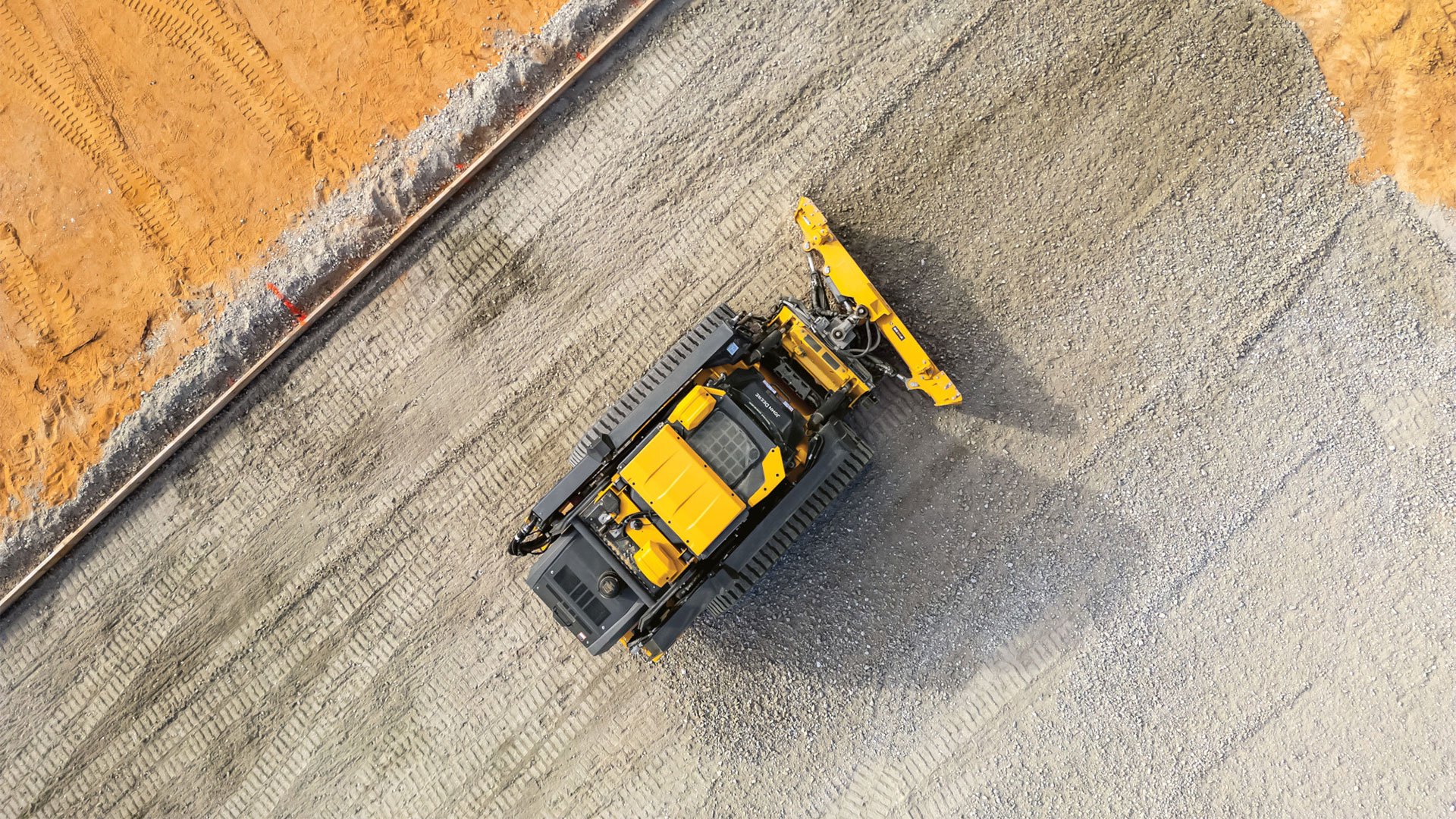
Grading and dirt work
The core skid steer competence. Every skid steer owner ends up with a general-purpose bucket. Beyond that:
- General-purpose bucket (comes with the machine, or is the first buy). Sized to the machine. 66 to 84 inch widths depending on the class.
- Rock bucket. Slotted floor for sifting rocks out of dirt while material handling. Frontier makes an AR10E 66-inch rock bucket for standard 300/400/500 series carriers.
- Land plane / grading box. For final grading and driveway maintenance. Faster and more precise than a bucket for grading work.
- Box blade. Better than a bucket for grading over larger areas with material handling. Ripper teeth make it useful for breaking up hardpack.
For most residential and light commercial contractors, a general-purpose bucket plus a land plane covers 80 percent of the dirt work.
Material handling
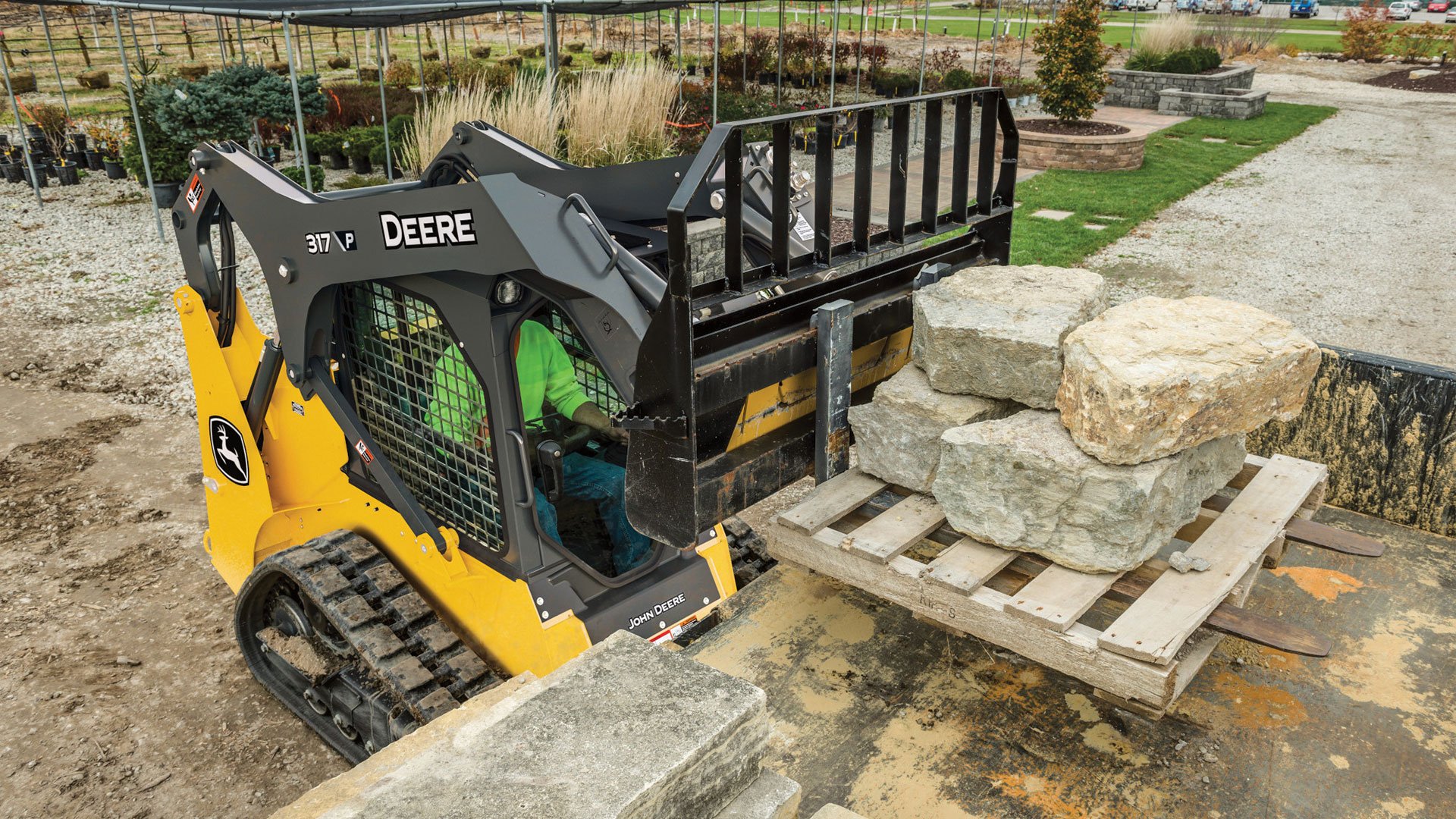
- Pallet forks. The single most-used non-bucket attachment for most contractors. Frontier's AP series (AP10F through AP13G depending on capacity and carrier) covers most needs. Verify the fork's capacity matches your machine's ROC.
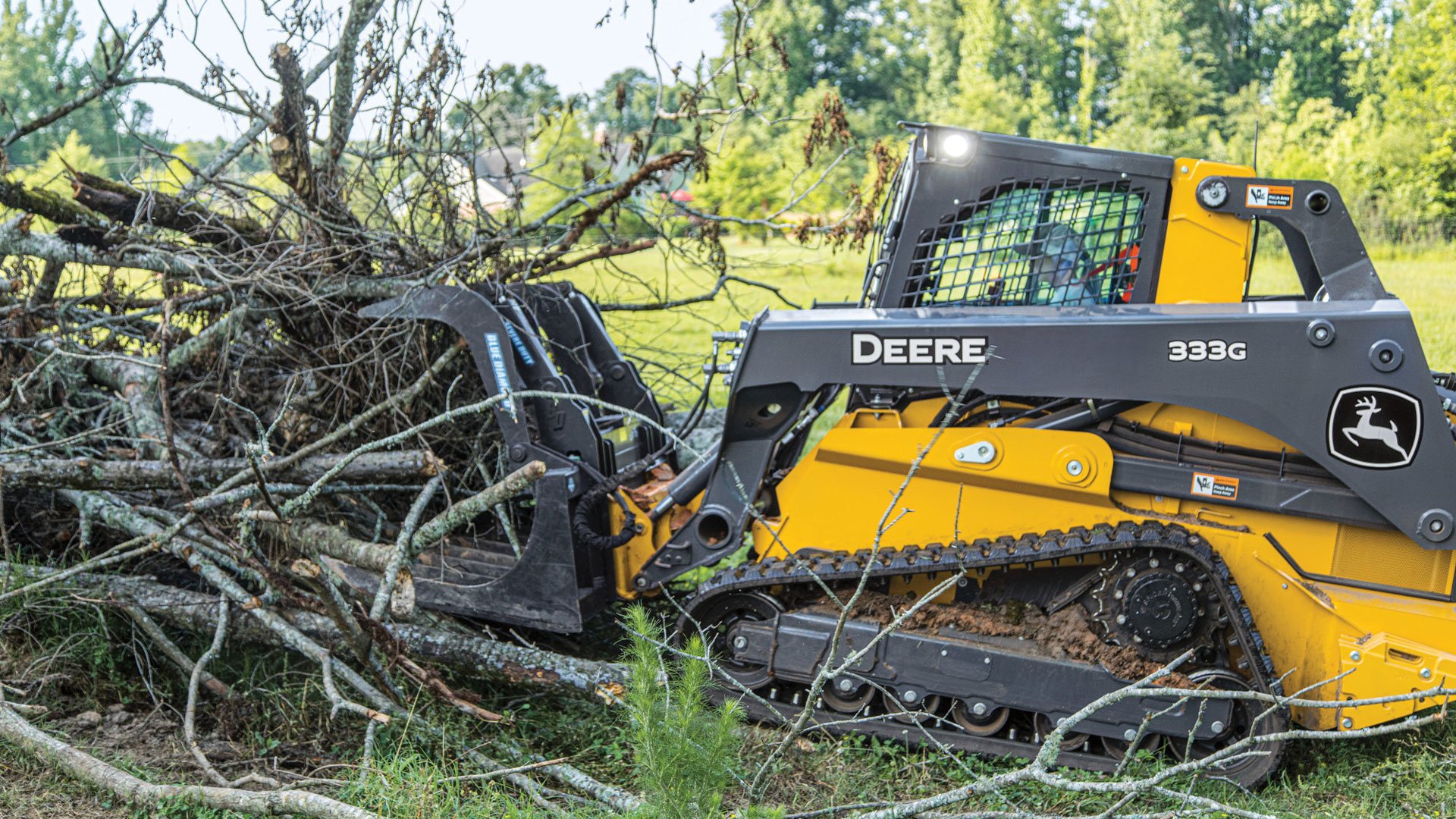
- Grapple bucket / debris grapple. Bucket with an upper jaw that closes onto loose material. Frontier's AD11E (72-inch for 300/400/500 series), AD11H (60-inch for 300/400 series), and AD12G (76-inch for 600/700 series) cover the main size classes. Essential for cleanup after any brush, tree, or debris job.
- Rock grapple. Similar to debris but built for rock. Different tine spacing.
- Bale spear / hay attachment. For agricultural operations that also run a skid steer.
Demolition and cleanup
- Grapple bucket. Doubles from material handling into demolition cleanup.
- Hydraulic breaker (hammer). Concrete removal, rock breaking. Requires high-flow hydraulics on most models. This is the attachment most likely to tell you your machine is undersized.
- Concrete claw / demolition grapple. Purpose-built for concrete demo cleanup.
Brush clearing and land management
- Rotary brush cutter. For pasture and rough mowing on land the machine can drive across. Standard flow works for smaller-diameter cutters. Larger-diameter high-production cutters need high flow.
- Flail mower. Better than rotary for tight brush around obstacles and less prone to throwing debris.
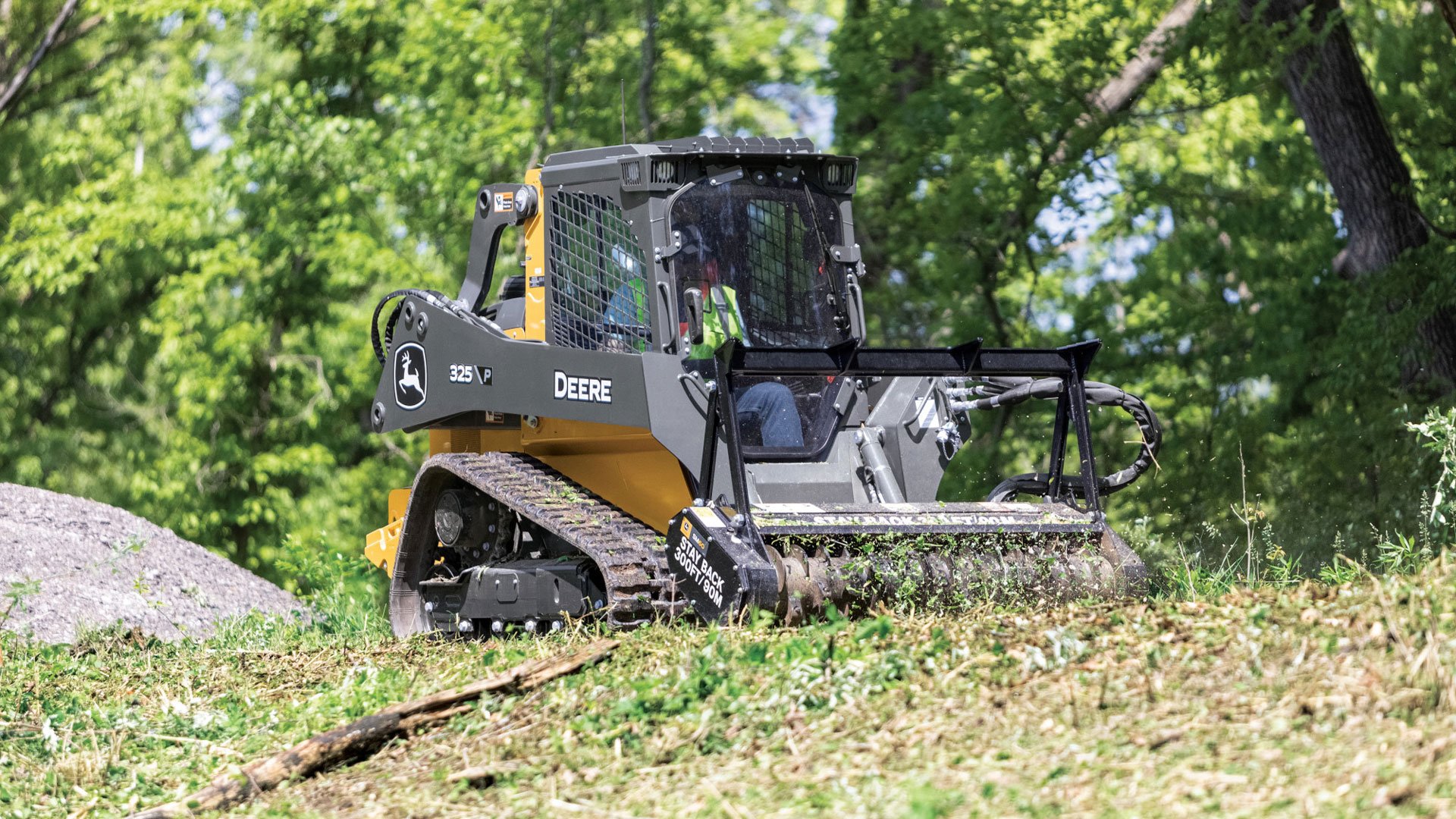
- Forestry mulcher. The heavy-hitter. Grinds brush and small trees into mulch. Requires high-flow hydraulics without exception. Case drain often required.
- Tree shear. For cutting standing trees at the stump. High-flow, requires case drain, and requires operator care.
Brush and forestry attachments are the category where the machine capability requirement escalates fastest. A standard-flow skid steer that ran everything else may hit its limit here.
Snow removal
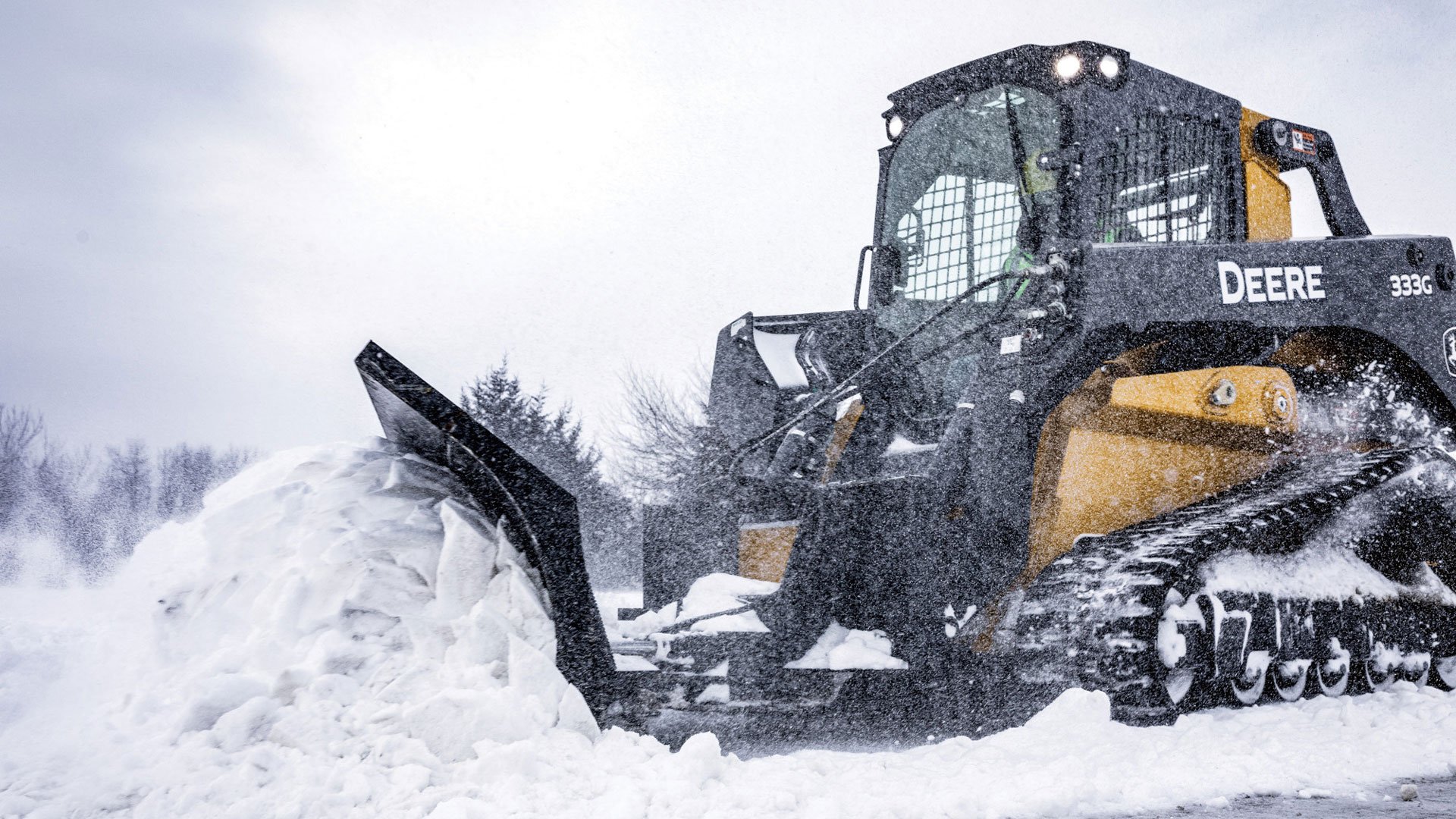
- Snow bucket. Wider, taller version of a bucket, meant for pushing snow rather than digging. Volume matters more than depth.
- Snow pusher / containment plow. V-shaped or box-shaped pusher for parking lot and driveway work. High-productivity for pushing large volumes.
- Angle blade. For directional plowing on longer runs.
- Snow blower. For deep snow that a pusher cannot handle. Requires high-flow hydraulics.
Snow attachments are the category with the most-common under-order problem. If snow is part of your fall/winter business, order these in July or August. By November they may be on backorder.
Augering
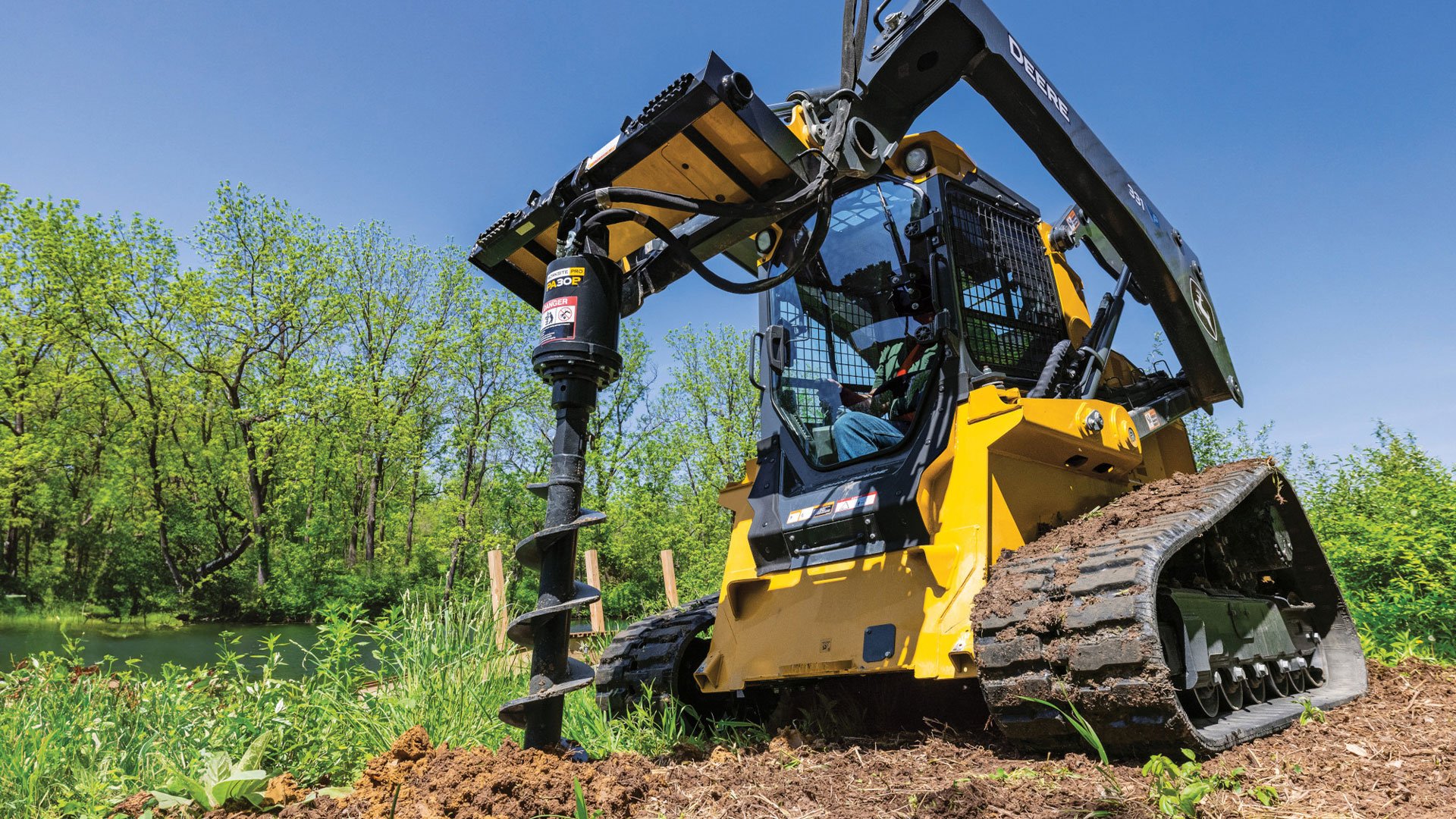
- Post hole auger. Fence posts, sign posts, small foundation piers. Standard flow works for smaller diameters (up to 12 inches). Larger diameters or hard soil may need high-flow.
- Tree spade auger. For tree planting operations.
- Foundation auger. Larger diameter, deeper. High-flow, purpose-built for pier work.
Specialty and utility
- Sweeper (angle broom or pickup broom). For construction site cleanup, parking lot maintenance. Angle broom is standard flow. Pickup broom with collector is often high-flow.
- Cold planer. For asphalt removal. High-flow, case drain required. Specialized commercial use.
- Trencher. For utility, drain, or irrigation trenching. High-flow.
- Vibratory roller / compactor. For soil compaction. Standard flow on smaller, high-flow on larger.
- Bale grab. For agricultural operations handling round bales.
If your operation touches any of these specialty categories more than once a year, buying rather than renting typically pays off within 18 months.
The universal quick-attach standard and what it does not cover
North American skid steers and compact track loaders overwhelmingly use the industry-standard Universal Quick-Attach mounting plate. This is why an attachment bought for a Bobcat generally fits a John Deere or a Case skid steer, and vice versa.
What Universal Quick-Attach covers:
- The mounting plate itself. Physical latching, tilt angle, bucket-and-pin compatibility.
What it does not cover:
- Auxiliary hydraulic connections. Coupler design varies. Flat-face couplers are the modern standard, but pin-and-ball couplers are still around on older machines. Verify.
- Electrical connections. 14-pin electrical connectors have become the standard for in-cab attachment control. If your machine has 14-pin and the attachment does too, in-cab controls work. If either does not, they do not.
- Case drain routing. High-flow attachments with internal motors often require case drain. This is a separate hydraulic connection that not every machine has plumbed.
For any attachment you are considering, verify: quick-attach fit (usually not an issue), coupler type match (sometimes an issue), 14-pin availability (if you need in-cab controls), and case drain (if the attachment requires it).
Frontier versus OEM versus aftermarket
Three sourcing options for most attachments. Honest breakdown.
Frontier (John Deere's implement brand). Purpose-built for John Deere machines, matched to the carrier series (300/400/500/600/700). Pricing typically in the mid-range. Support and parts through your John Deere dealer.
John Deere OEM. The larger construction-grade attachments and specialty items directly from John Deere. Higher price, higher build quality for high-hour commercial use.
Aftermarket. Multiple brands (Blue Diamond, Wolverine, and others) available through equipment supply channels. Wider product selection, often lower price, mixed quality. The best aftermarket brands are excellent. The worst have gaps in customer support and parts availability that show up at the worst time.
Our recommendation for most contractors: Frontier for the standard-use attachments (buckets, pallet forks, debris grapples, land planes), OEM for anything that will see very high hours, and aftermarket only for specialty attachments where Frontier does not offer an equivalent.
Our June 11, 2026 Frontier Attachments Buyer's Guide covers the Frontier lineup in more depth, and while that post is compact tractor-oriented, most of the same principles and many of the same product families apply to skid steer applications.
When your attachment tells you the machine is undersized
The tell-tale moment. You buy a mulcher, or a heavy hydraulic breaker, or a high-production sweeper, and the machine that ran everything else starts to labor. Overheating on a summer afternoon. Slow hydraulic response. Auxiliary flow not keeping up.
This is the machine telling you the attachment you need has outgrown the class you own. Two paths forward:
- Rent the specialty attachment work. For jobs you take on occasionally that push the machine, renting a specialty attachment through us (or renting a larger machine with the attachment) is often cheaper than upsizing your machine.
- Upsize the machine. For work you do regularly, the right move is a bigger machine. This is the point where the current 0 percent APR for 60 months on Track Skid Loader and Skid Steer purchases (running through September 30) or the 0 percent APR for 36 months on Utility Tractor and Skid Steer purchases (running through October 30) becomes worth the conversation. The financing programs for commercial contractor accounts are the strongest they typically get during any window in the summer, and if you were going to upsize anyway, doing it while these programs are live materially changes the payment math.
Either path is a legitimate answer. What is not the right answer is running the attachment on an undersized machine and burning out either the attachment, the machine's hydraulic system, or both.
The three attachments most contractors under-buy
Recurring pattern we see at the counter, in case any of this rings true for your operation.
A grapple bucket. More versatile than a straight bucket. Every job cleanup goes faster. Once you own one, you use it more than you thought you would.
A land plane. Grading a driveway with a bucket is possible but slow. A land plane with laser leveling capabilities in the higher trims is 3 to 5 times faster and produces better results.
Snow attachment if you touch snow at all. Every October we take calls from contractors who did not order their snow attachment early enough and now cannot get it. If snow is 10 percent of your annual work, order in July.
When to call us
Two practical notes.
For attachment selection help specifically, our sales team can walk through your machine's spec sheet with your job list in about 20 minutes and identify the specific attachments that will match. This is exactly the kind of conversation we set up for.
For any attachment order, current lead times run 5 to 15 business days on common Frontier attachments and can stretch to 30-plus days on specialty items in peak season. Ordering in July for a snow attachment you will need in November is not too early.
Not sure which compact machine is right for you?
Answer a few quick questions and Koenig will match you to the right John Deere machine for your jobsite, based on how you work and what you need.