Published: July 1, 2026
Updated: October 1, 2026
|
There is a moment most tractor owners hit somewhere in their second or third year of ownership. The tires that came with the machine are starting to look different. The lugs are less crisp. The sidewall has a wear pattern that wasn't there before. The traction in wet grass or loose dirt is not quite what it used to be. And the question shows up at the parts counter: are these worth replacing, and if so, what should I replace them with.
We get a version of that conversation every week through summer at our parts counters across Ohio and Indiana. The answers are not always obvious, and the wrong answer can cost real money. A set of four R1 ag tires on a 5-Series tractor will run more than $3,000 installed. A set of R4 industrials closer to $4,000. Wrong tire choice for the work the tractor actually does is a long, expensive regret.
This is the version of that conversation we wish every customer would read first.
R1, R3, R4: tread patterns translated
The first decision in any tractor tire conversation is tread pattern. The industry uses three letter codes that mean exactly what they sound like once somebody explains them, and almost nothing if no one ever does.
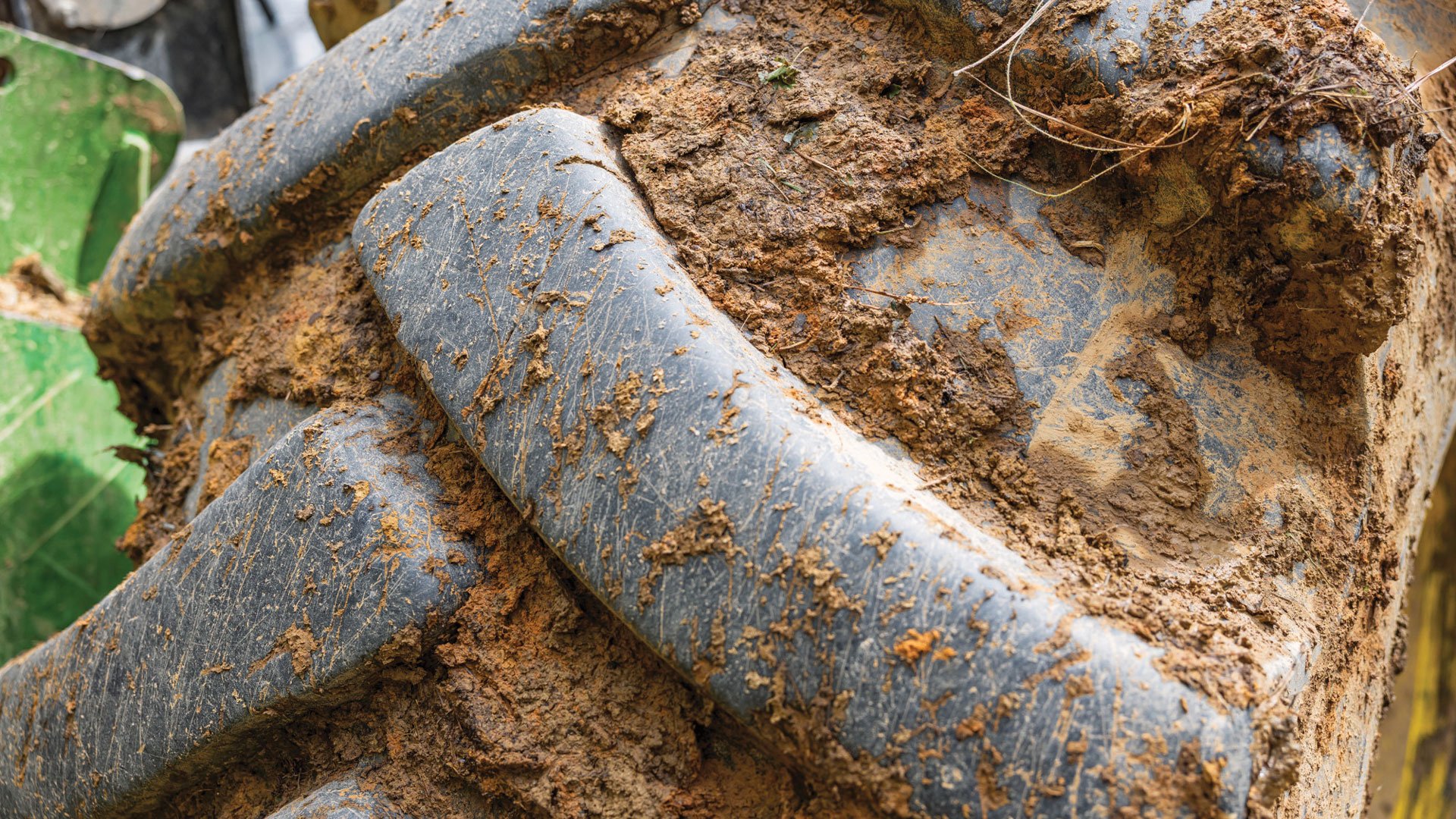
R1: Agricultural lugs. Tall, aggressive bar lugs designed to bite into soft soil and self-clean. R1 is what you want if your tractor's primary job is field work, tillage, mowing pasture, hauling on bare dirt, or anything where traction in wet or soft ground matters more than turf protection. There are R1W (wet) and R1WF (rice and cane) variants for heavy mud and standing water. For most Ohio and Indiana farm use, standard R1 is the right answer.
R3: Turf. Shallow, smooth, closely-spaced lugs designed not to tear grass. R3 is the right choice when the tractor primarily lives on a manicured lawn, a horse property, a golf course, or any surface where leaving tracks is a problem. R3 gives up traction in wet conditions, especially on slopes, in exchange for surface protection.
R4: Industrial. Medium-depth, wider lugs designed for hard-pack surfaces, gravel, asphalt, and mixed terrain. R4 tires last longer than R1 on hard surfaces and damage turf less than R1, but they do not perform like a true R1 in soft dirt and do not protect turf like a true R3. R4 is the compromise tire and it is genuinely the right pick for most compact tractor owners who do a mix of light farm work, gravel driveway maintenance, loader work, and some yard time.
The honest summary: if your tractor does serious field work, R1. If it lives on the lawn, R3. If it does a bit of everything, R4. Most compact tractors leave the lot on R4 for a reason.
When to replace versus rotate
Tractor tires do not wear evenly. The rear tires take the drive load and the front tires take the steering load, and on a 4WD or MFWD machine the wear pattern is different from a 2WD machine. Knowing what you are looking at saves a lot of money.
The replacement triggers we use at the service counter:
- Lug height down to 50 percent. R1 ag tires have visible wear bars in the lug valleys. Once the remaining lug is at or below half of original height, traction in soft conditions starts to fall off measurably. Below 25 percent, the tire is mostly cosmetic.
- Sidewall cracking. UV damage and age-cracking show up as fine cracks running circumferentially around the sidewall. Surface cracks are usually fine. Cracks that show cord or that go more than a quarter-inch deep are a flag.
- Cupping or scalloping. Uneven wear in patterns suggests an alignment or pressure issue. Replacing tires without fixing the underlying cause means you replace them again sooner than you should.
- Cracked or split casings. Anything that has reached the inner cord is done. Repair on a tractor tire of this size is rarely cost-effective.
Rotation is genuinely useful on MFWD compacts where the front tires are smaller and the wear ratio between front and rear matters for the drivetrain. The general guideline is that the front and rear tire diameters need to stay within roughly 5 percent of the manufacturer's specified ratio. Once they drift outside that, the front axle is being driven against the rear and the drivetrain takes the load.
If you are not sure what shape your tires are in, bring the tractor in. A service inspection that includes tire wear, pressure check, valve inspection, and rim condition is usually a 30-minute conversation that saves you from buying tires you did not need to buy yet.
How to read a tractor tire size
Tractor tire sidewalls look like an alphabet soup until somebody decodes them. There are two main formats.
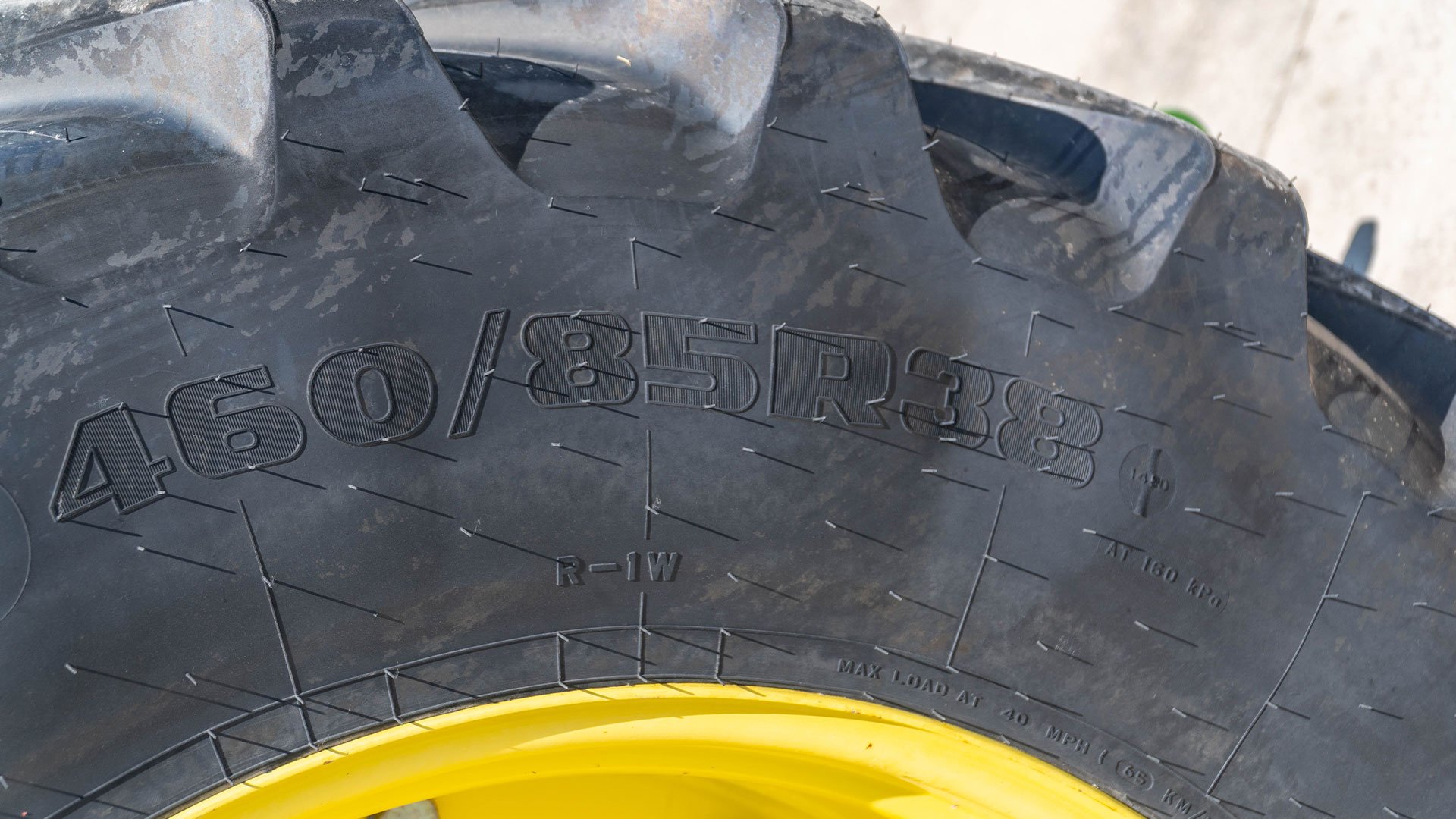
Conventional sizing (older but still common): something like 18.4-30 or 14.9-24. The first number is the section width in inches, the second is the rim diameter in inches. A 14.9-24 is a 14.9-inch-wide tire for a 24-inch rim.
Metric sizing (newer, especially on radial tires): something like 380/85R24. The 380 is section width in millimeters, the 85 is the aspect ratio (sidewall height as a percentage of width), R means radial, and 24 is rim diameter.
Two things to know:
1. Section width is not tread width. A 14.9-24 has a 14.9-inch sidewall-to-sidewall measurement, but the actual rolling contact patch is narrower than that. 2. You cannot mix bias-ply and radial on the same axle. The construction is different and the wear and ride characteristics will fight each other.
When you call us for replacement tires, the numbers we need are the size code off the sidewall, your tractor model, and ideally a picture of the tire and rim. With those three things we can match to the correct replacement, including any superseded sizes that match the original spec.
Tire pressure for working conditions versus road use
This is the area where the biggest performance gain hides in plain sight on most tractors. Field operating pressure and transport pressure are not the same number, and most owners run the same pressure year-round.
The general guidance:
- Field work pressure. Lower than transport. On a typical compact tractor R4 rear tire, this might be 16 to 20 PSI. On a larger ag R1 rear, it may be 10 to 14 PSI. Lower pressure increases the contact patch, improves traction in soft ground, and reduces soil compaction.
- Transport and road pressure. Higher. The same R4 might run 22 to 28 PSI on the road. Higher pressure reduces sidewall flex at speed, reduces heat, and protects the casing on hard surfaces.
The actual right numbers are stamped on the sidewall (maximum cold pressure) and listed in the operator's manual for your machine. The biggest mistake we see is running field pressure on the road. The casings heat up, the sidewalls fatigue, and tires that should have lasted 8 to 10 years fail at 4 to 5.
If your tractor has a pressure-monitoring system, use it. If it does not, a $20 truck-tire gauge and a 5-minute pressure check on the first warm day of the season is one of the cheapest preventive maintenance habits you can build.
Liquid ballast: filling tires with water or beet juice
Filling tractor tires with liquid is one of the oldest tricks in agriculture, and it is still one of the most useful. Liquid ballast adds rear-axle weight, which improves traction and reduces front-end lift when the loader is loaded. Done right, it is invisible and lasts the life of the tire.
The basics:
- Why. Liquid ballast in the rear tires adds roughly 75 percent of the tire's air volume in weight. On a typical compact R4, that is several hundred pounds per tire, all of it low and centered exactly where you want weight for traction.
- What fluid. Water alone works in summer but freezes in winter. Calcium chloride solution was the traditional answer but corrodes rims. Beet juice (a glycol-and-sugar-based product, often sold under the Rim Guard brand) is the modern preferred fluid: heavier than water, non-corrosive, non-toxic, and freeze-resistant well below Ohio and Indiana winter temperatures.
- How much. Tires are typically filled to 75 percent capacity, with the remaining 25 percent left as air. This is sometimes called "filling to the stem" because the valve stem sits at the top of the tire when in the fill position.
- Cost. Expect somewhere between $150 and $400 per tire to have ballast installed at our service department, depending on tire size and fluid choice.
Filling tires is not a job we recommend you do yourself unless you have done it before. The wrong process introduces air pockets, contaminates the fluid, or stresses the valve in ways that show up as slow leaks months later. It is a job that pays for itself in the doing-it-right.
Used versus new tires: what actually saves money
The math on used tractor tires is harder than it looks.
The case for used: A set of takeoff tires from a low-hour trade-in can be 40 to 60 percent of the new price for tires with 70 to 80 percent of their tread life remaining. If you find the right set in the right size, used can be a real win.
The case for new: Used tires of unknown age can have UV damage, hidden sidewall cracking, or casing fatigue that does not show up until they are mounted and pressurized. The labor to mount and dismount tires on a large tractor is real and is not refundable when a tire fails after two weeks.
The honest version: used tires can be a smart purchase from a dealer you trust, where you can see the wear pattern and the casing condition before you buy. Used tires from a Craigslist seller, especially at high age, are a gamble that does not pay off as often as people hope.
If you want to look at used options, our Tires and Tracks used inventory carries takeoffs and tested used sets from trade-ins.
Tire-related damage to rims and hubs
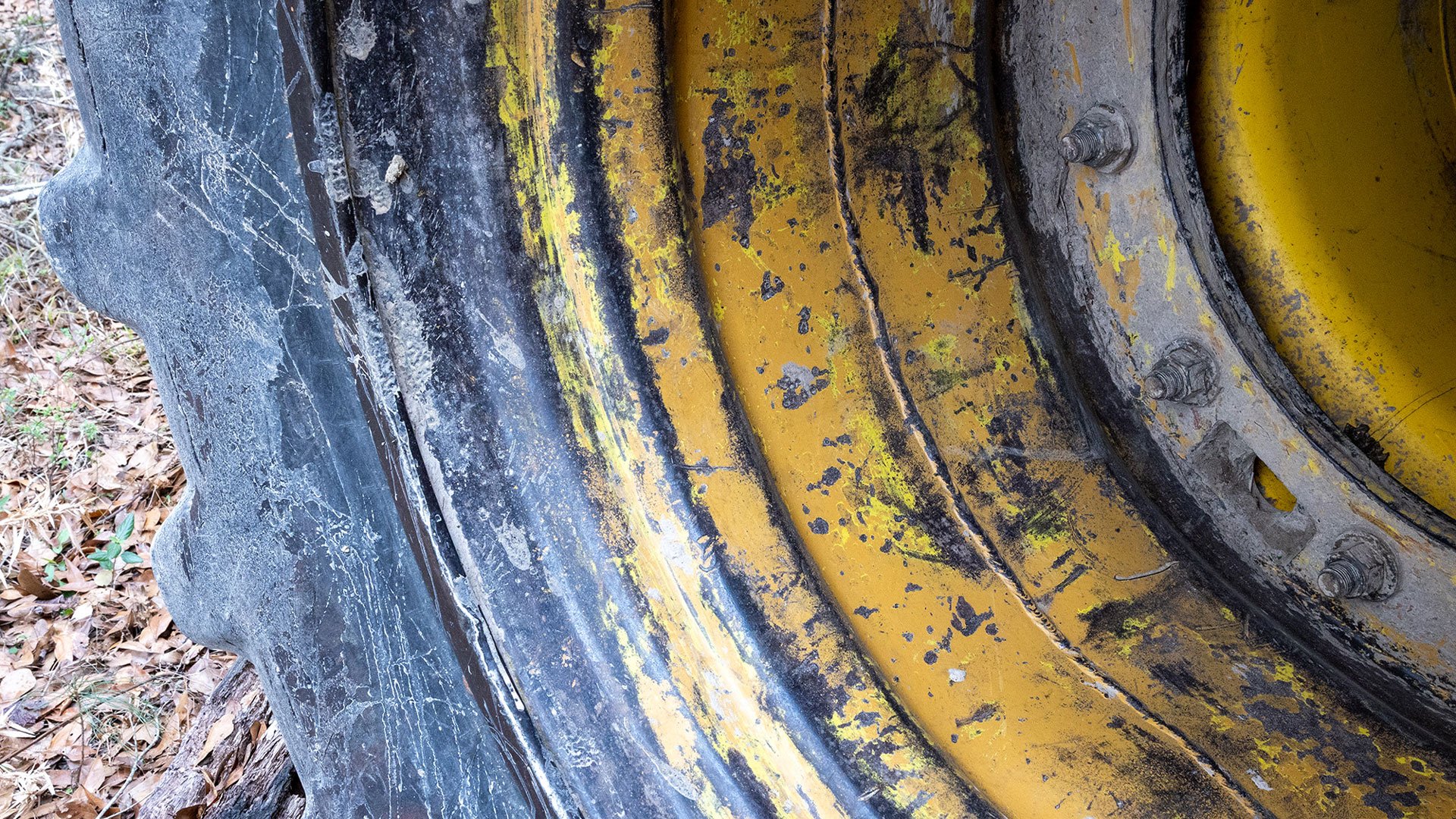
The piece of this conversation that most owners never think about is the rim. Tire problems eventually become rim problems if they are ignored, and rim replacement is significantly more expensive than tire replacement.
What we look at when a tractor comes in for tire work:
- Bead seat condition. The bead seat is the lip on the rim where the tire's bead sits. Rust, pitting, or any kind of irregular surface there causes slow leaks and uneven tire seating.
- Liquid ballast corrosion. Older calcium chloride installations sometimes corrode rims from the inside. A visual inspection during a tire change is the only way to catch this before the rim fails.
- Wheel hub bolts and clamp marks. Loose lugs leave witness marks. Witness marks are an early warning that the next set of tires deserve a careful look at the hub mounting surface.
- Rim cracks. Cracks at the bolt holes or around the valve stem are uncommon but serious. Driving on a cracked rim is dangerous and we will not remount a tire on a damaged rim.
If you see liquid weeping from a wheel that should be sealed, see flaking rust around the rim, or hear unusual noises from the wheel area at speed, bring it in. Rim issues caught early are repairable. Caught late, they require replacement.
When to call us
Two practical notes for owners.
For an inspection without replacement, our service teams can do a tire and rim check at any of our locations in roughly 30 minutes. We will tell you honestly whether you need new tires now, can rotate to extend the life of what you have, or have a different issue (pressure, alignment) causing what looks like a tire problem.
For replacement, the lead time on common tractor tire sizes is usually one to three days. Less common sizes can take a week. Late June and early July is one of the busier windows of the year for tire work, so calling sooner is better than later if you want to be back in the field this week.
If you want the focused timing-only conversation, our October 2024 post on when to replace your tractor tires covers that single question in more depth.