Published: July 23, 2026
Updated: October 1, 2026
|
If you drove around any Ohio or Indiana county this past weekend, you saw the same thing we did on our own lots. Front yards that were still keeping up in early June are visibly checking out now. Brown edges around driveways. Dry patches under mature trees. The mid-summer stretch is showing up hard this year, and the phone at our parts counter starts ringing every July with the same question from homeowners: is it hurting my lawn to mow it right now, and if I do mow, how do I do it without making it worse.
This is the short, honest version of that conversation. The advice applies whether you run a lawn tractor, a zero turn, or something in between, and it applies whether your property is a suburban quarter-acre or a working small farm's front yard.
The single change that matters most: blade height
If you take one thing from this post, take this. Raise your blade height. Do it today.
The default cutting height most homeowners use through spring is 2.5 to 3 inches. That is fine for actively growing turf on a normally moist year. In drought, that same height puts the grass under real stress. The taller the leaf blade you leave, the more surface area the plant has to photosynthesize, the deeper it drives roots, and the more shade it puts on its own root zone. All three of those directly protect the lawn during hot dry weeks.
The practical rule: raise your blade to 4 inches or the highest setting your deck offers. On most residential lawn tractors and zero turns, that is the maximum notch on the deck lever. If you are cutting cool-season grass (Kentucky bluegrass, tall fescue, perennial rye) that is the standard mix in this region, this move alone will keep more of your lawn alive through a dry August than any other single thing you can do.
The exception is if your lawn was already mowed short heading into the dry stretch and you cannot afford to remove more leaf tissue than absolutely necessary. In that case, skip the next cut entirely. Cutting one-third of the leaf per pass is the working rule any time of year. In drought, it becomes closer to one-fifth. If the grass is barely growing, mowing it is doing more harm than good.
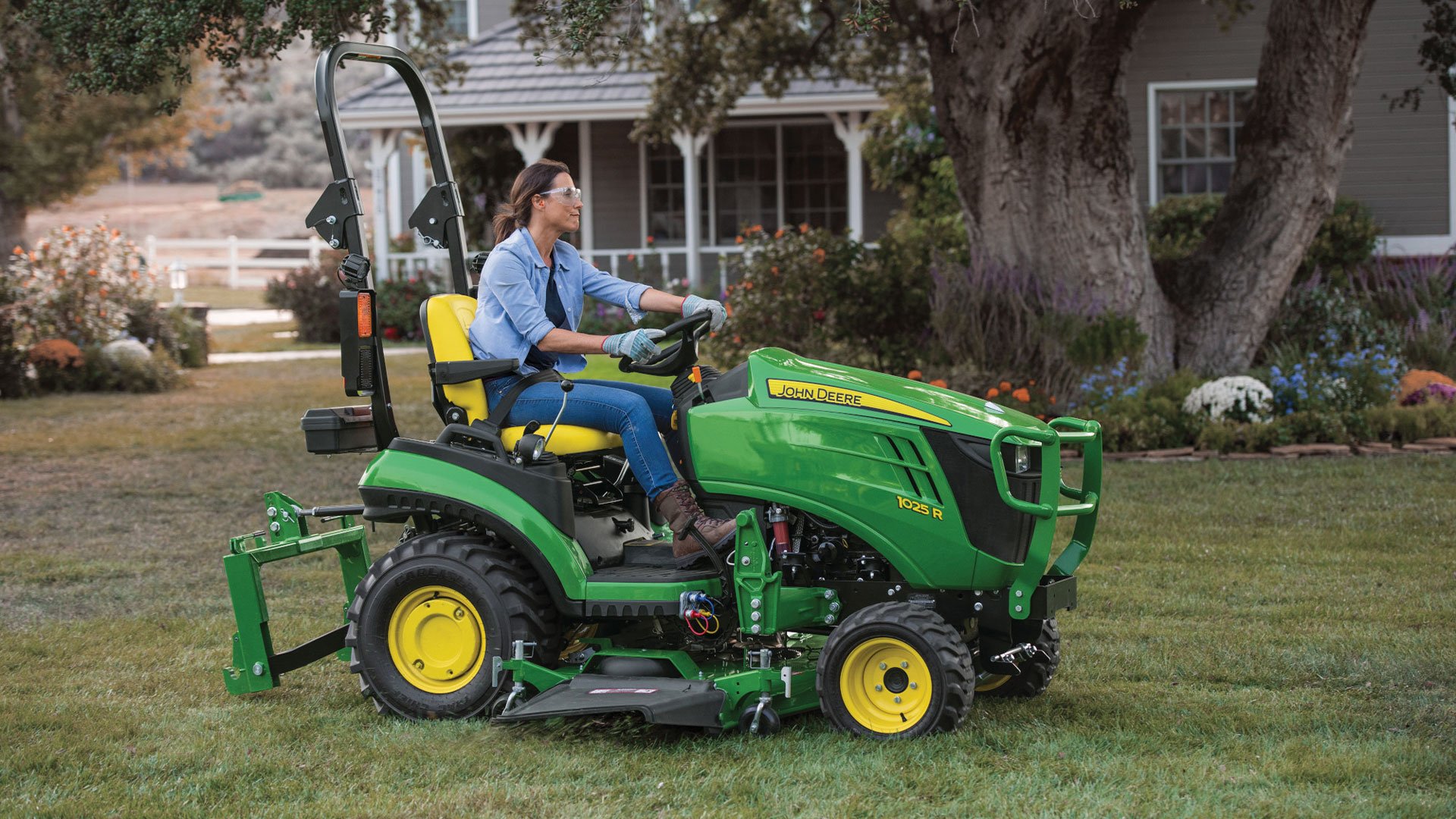
Sharp blades matter more in drought than any other time
The second most important adjustment is not about the machine's height. It is about the sharpness of the blades on it.
A dull blade does not slice the grass. It tears it. On a healthy well-watered lawn, that damage heals in a day or two. In drought, the plant does not have the resources to heal, and the torn leaf tips brown out and die back. Multiply that by every blade of grass on the property, and a dull-blade cut in drought is what actually kills a lawn that would have otherwise survived.
The tell-tale sign your blades need attention: white or brown-frayed leaf tips visible the morning after mowing, especially on longer sections. Bend down and look at a random cluster of grass blades close up. Cleanly cut tips are sharp. Ragged, torn, or shredded tips mean the blades need sharpening or replacement.
A sharp cutting edge is not optional in drought. The choice is:
- Sharpen the blades you have. Every mower blade can be re-sharpened two to four times over its service life before the metal gets too thin. A homeowner with a bench grinder and some patience can do this. Most people bring their blades to our service department because a well-sharpened blade balances properly, and an unbalanced blade wears deck spindles fast.
- Replace with new. If your blades have been sharpened three times, are visibly worn, chipped, or bent, replace them. Blades are consumable and are typically $20 to $40 each depending on model. Compared to the cost of losing part of a lawn, this is a small investment.
Our service department can sharpen or replace mower blades in about the same time it takes to do a routine service. If you have not sharpened yours this season, this week is the right time.
Mow in the evening, water in the morning
Timing matters as much as technique. Two working rules for drought mowing:
Mow late afternoon or evening. Never mow in mid-day heat, and try to avoid mowing when the sun is directly on the lawn. Freshly cut grass in mid-day heat loses more water through cut leaf tips and dries faster. Late afternoon or early evening cuts give the plant an overnight recovery window before the next full sun day.
Water in the early morning. If you can water. Some water restrictions may be in place; check with your municipality. If watering is allowed, 5 to 9 am is the ideal window. Water applied at that hour has time to soak in before the sun evaporates it and gives the grass hours of full-daylight photosynthesis with adequate moisture. Watering in the evening looks convenient but leaves the lawn wet overnight, which promotes fungal disease. Watering at noon wastes 30 to 40 percent of the water to evaporation.
The most common mistake we see homeowners make is watering too often and too shallowly. A deep watering once or twice a week (about 1 inch total per week from all sources including rain) drives roots deeper and produces a more drought-tolerant lawn than a light daily watering. If you can only water twice a week, do so deeply. Half an inch each time.
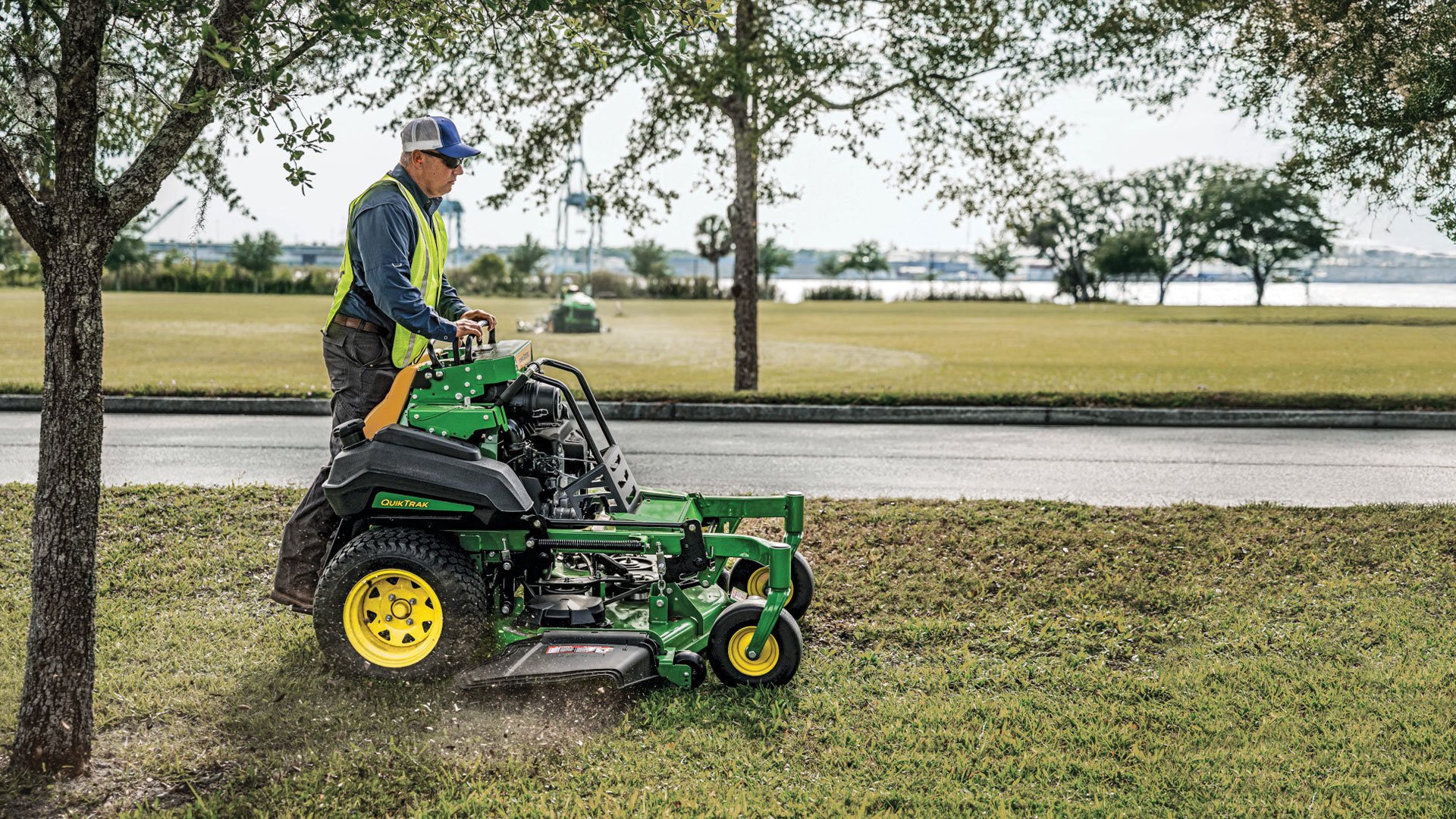
Deck speed and machine settings
Most residential mowers do not have separately-adjustable deck speed as a user setting. The deck runs at a fixed RPM matched to engine speed. What you can adjust is ground speed.
For drought conditions:
- Slow down. Ground speed slower than your normal fast pace lets the blades make cleaner cuts on brittle drought-stressed grass. Fast ground speed on brittle grass creates ragged tears rather than clean slices, worsening the stress problem.
- Overlap slightly more than usual. Missed strips are more visible in drought because the missed strip continues to grow while the cut strip goes dormant. A little extra overlap is worth it.
- Turn wider. Zero-turn spins on drought-stressed grass tear up turf that is barely rooted. Wider three-point turns are worth the extra minute.
- Bag or mulch depending on conditions. In a normal year, mulching returns nitrogen to the lawn and is the right default. In severe drought where clippings would sit on top of the grass without decomposing, bagging avoids smothering already-stressed turf. Most Ohio and Indiana drought conditions do not reach that severity; mulching is usually still the right call.
When to skip a cut entirely
Every year we get calls in August from homeowners who feel guilty about not mowing for two weeks. The right answer is often: good, do not mow.
The working framework:
- If the grass is not visibly growing (still at your last-cut height a week later), skip the cut. The plant is dormant. Cutting it does not help it and does damage the leaves it will need for recovery when rain returns.
- If the grass is growing but slowly, mow at the highest setting and only cut off the top third of what has grown. If it grew half an inch since last week, take a quarter inch off.
- If the grass is browning through the whole property rather than just isolated patches, the entire lawn is in stress-dormancy. Skip mowing until you see fresh green growth returning.
Dormant grass looks bad. It is not dead. Kentucky bluegrass and tall fescue can survive 4 to 6 weeks of dormancy and return to normal color within days of adequate rainfall. Cutting dormant grass shortens its recovery timeline and reduces its odds.
Fertilizer and herbicide during drought: what not to do
Two quick rules that fold into the mowing conversation because they affect the same lawn.
Do not fertilize during active drought stress. Nitrogen application drives the plant to grow, and growth requires water it does not have. Fertilizer applied to drought-stressed turf frequently burns the grass, sometimes badly. Wait until you have received meaningful rain and see fresh growth returning before applying summer fertilizer.
Do not apply broadleaf herbicides in high heat. Most herbicide labels list maximum temperatures (often 85 or 90 degrees) above which the product volatilizes or damages the lawn along with the target weeds. Read the label. If the daily high is above the temperature threshold, wait. This applies whether you use a granular weed-and-feed or a spray-based product.
Both fertilizer and herbicide decisions can wait until the September and October window when temperatures moderate and rains typically return.
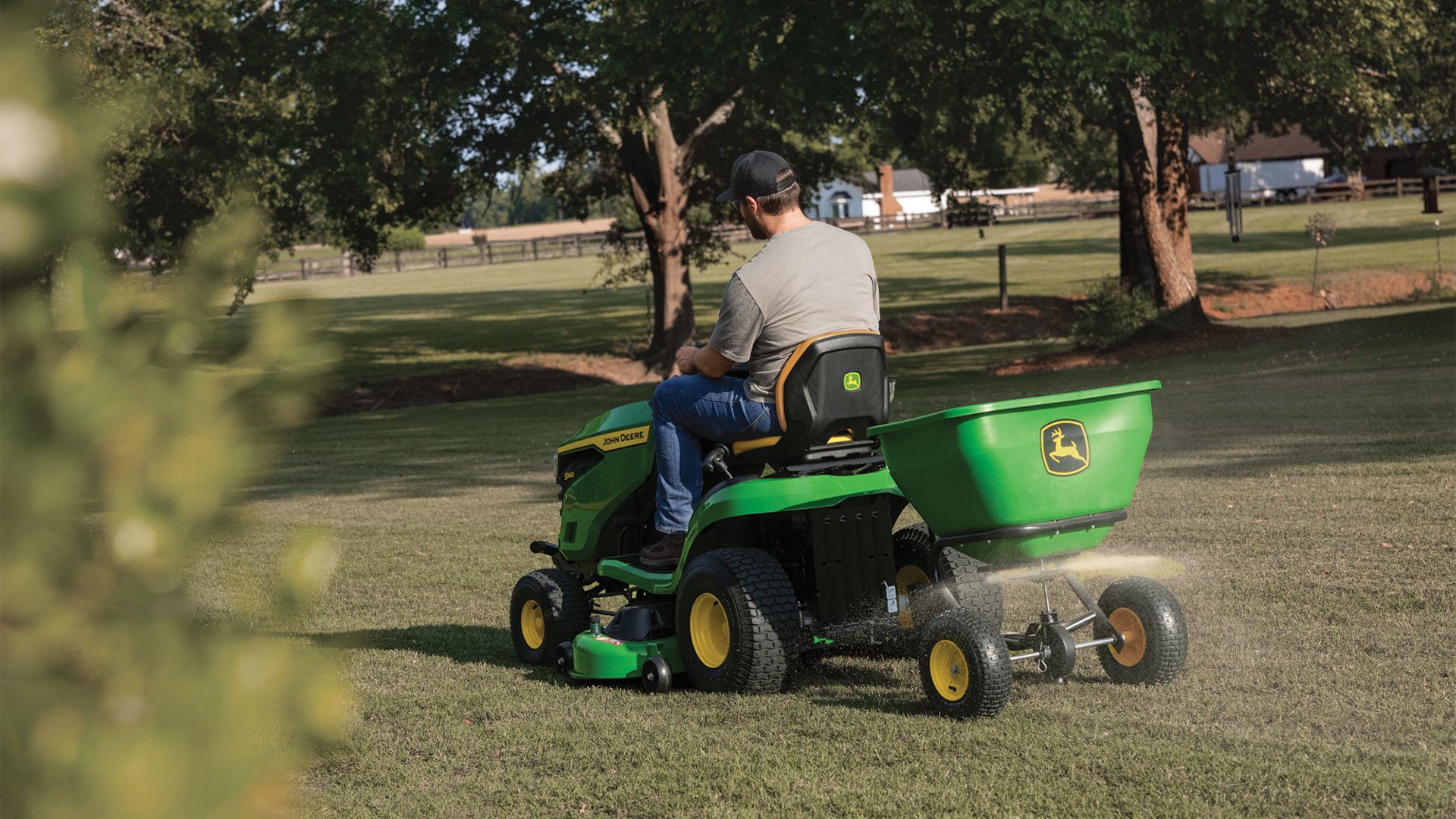
Both lawn tractor and zero turn owners: same principles, different mechanics
Everything above applies whether you run a John Deere X300 or X500 series lawn tractor, a Z300 or Z500 series zero turn, or a Gravely, Ferris, or other machine. The physics of grass and drought is the same.
Two mechanical notes specific to zero turn owners:
- The zero turn's speed advantage is a drought disadvantage. Zero turns are fastest, and speed on drought-brittle grass tears more than a slower lawn tractor pass. If you have both machines, the lawn tractor is often the better tool during drought conditions.
- The zero radius pivot tears turf hard. In drought, the tearing shows up worse and takes longer to recover. Wider turns on the zero turn are not just a courtesy to the lawn, they are how you protect it.
If drought conditions have you rethinking your mower entirely, our June 30 Lawn Tractor vs Zero Turn 7-year TCO analysis covers the platform-choice math including scenarios like this one where the "faster" machine is not always the better one for the situation. And if you are looking at newer mower options this summer, John Deere is currently running $200 to $400 off select Z300 and Z500 series zero-turn mowers and X300 lawn tractors through early August, alongside 0 percent APR for 36 months on qualifying residential mowers. Worth a look if the current machine is not doing what you need.
When to call us
Two practical notes.
For blade sharpening or replacement: Our service department turns mower blades around quickly and can typically get you back on the yard the same day if you drop them off early. Sharp blades in drought are not optional. If you cannot remember the last time yours were sharpened, this week is the answer.
For any mower not running right: Late-summer heat exposes cooling system weaknesses, belt wear, and battery issues on mowers that ran fine in April. If your mower is struggling, running hot, or not cutting like it used to, bring it in. Our team can typically diagnose within a few minutes and often has replacement parts on the shelf.
Related reading
For the broader "which mower for my property" conversation, our June 30 Lawn Tractor vs Zero Turn 7-year cost analysis covers the platform decision in detail. For general zero-turn upkeep beyond drought conditions, our May 26 Zero Turn Maintenance guide is the companion mid-season maintenance piece.
Find parts for your X300
Shop genuine John Deere parts that fit the X300 and X500 at Koenig Marketplace — search by your exact model to see what fits.
Not sure which mower is right for you?
Answer a few quick questions and Koenig will match you to the right John Deere mower for your property, based on how you work and what you need.