Published: August 20, 2026
Updated: August 20, 2026
|
Walk into any Koenig used equipment lot the second and third weeks of August and the compact tractor inventory looks different than it did in April. Not just because different specific units are on the lot, but because the mix and character of what is available has shifted in ways that reward buyers who understand what they are looking at.
This is a working guide to how the used compact tractor inventory cycle actually operates through the year, why late August is one of the better shopping windows on the calendar, and what to look for in a trade-in depending on where it likely came from. It is the direct follow-up to the June 23 first-used-compact-tractor guide and assumes you have already worked through the fundamentals of used-compact shopping.
The seasonal inventory cycle in a compact tractor lot
Used inventory does not arrive at a dealer uniformly across the year. There are two peaks and two troughs, and the peaks are meaningfully asymmetric.
Late spring peak (April through early June). Property owners upgrade from an older tractor to a new one before the peak yard and property season. Landscape contractors and rural residential upgraders both feed inventory into this window. Trade-ins arrive at the lot 30 to 45 days after the sale that generated them, which means dealer inventory peaks in June and July.
Late summer peak (August through early October). This is the harder-to-see cycle. The buyers who bought new tractors in April and May are trading in the older machines they upgraded from. Small landscape contractors who added a second unit are rotating out their previous primary. Estate sales and property downsizes concentrate in this window as families move properties before winter. And commercial mowing operations that ran hard through peak season decide which unit gets rotated out for the coming year.
Fall trough (November through January). Inventory turnover slows dramatically. Buyers who wanted a tractor before winter have bought. Sellers looking to move a unit are usually holding it until spring for a stronger price. Selection narrows and average unit condition tightens toward the higher end.
Winter trough (January through mid-March). The absolute lowest inventory point of the year, coupled with the softest pricing on units that do move. Great buyer window if you find the right unit, difficult buyer window if you need to see multiple options.
The takeaway is that late August through early October is genuinely the window where the deepest selection of freshly-arrived used compact tractors lands on dealer lots. It also happens to be the window where trade-in valuations coming from spring new-tractor buyers have been processed and the units are appearing on the retail side.
What "fresh trade-in" means for the buyer
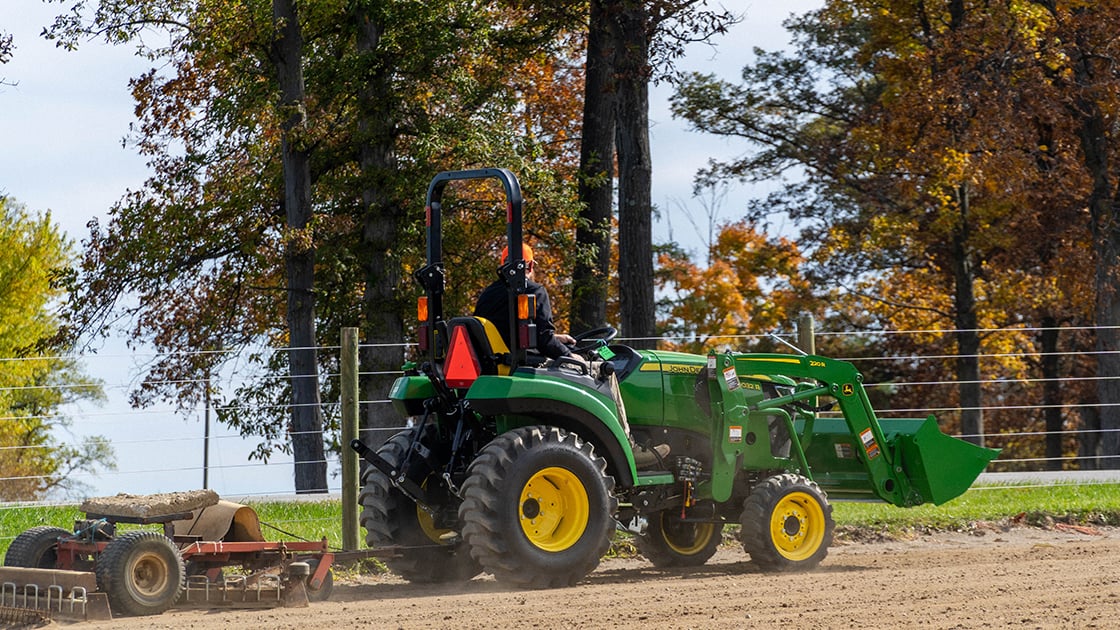
A used compact tractor that landed on the lot two weeks ago has been through a specific process. The trade appraisal generated a value against the new purchase. The unit came in on a trailer to the receiving location. It was cleaned, inspected, and had a service history pulled. Any obvious needs were addressed by our shop before it moved to the retail side. Photos and listing details were prepared. The unit hit the online inventory system.
For the buyer, this means a few concrete things.
First, the specialist selling you the tractor knows more about it than about a unit that has been on the lot for six months. The service history is fresh, the walk-around inspection details are recent, and any conversations with the trade-in owner about known issues are still in recent memory.
Second, the pricing on fresh trade-in inventory reflects current market conditions rather than a listing that has been sitting through market shifts. Used compact tractor pricing has moved meaningfully over the past several quarters, and units priced today reflect where the market actually is.
Third, the mechanical condition on fresh trade-ins is often better than what shows up on longer-standing lot inventory. Not always — some trade-ins arrive with real needs, and they get addressed before retail listing — but the average condition of the freshly-arrived tier tends to be strong.
Reading the trade-in profile
Here is where the applied piece gets interesting. A used compact tractor from a landscape contractor looks different than one from a hobby farmer, and neither looks like one from an estate sale. Understanding the previous-owner profile changes what to inspect and what questions to ask.
Landscape contractor trade-in. Typically higher hours (400 to 1,200 hours on a 3-to-5-year-old unit). Well-used but usually maintained on a schedule because commercial owners depend on the machine. Loader work is intensive, so front-end wear, hydraulic hose condition, and loader mount points get more attention. Deck condition can vary. Cabin wear and controls typically show heavier use. These are often strong buys for another commercial user or a property owner who wants a proven working tractor and can accept cosmetic wear.
Hobby farmer or rural residential trade-in. Typically low hours (75 to 300 hours on a 3-to-5-year-old unit). Sometimes very well maintained, sometimes very poorly maintained. The bimodal distribution is real: the meticulous owner who serviced every 50 hours and the owner who ran it for four years and never changed the oil are both in this population. Ask specifically about service history, and look for documentation. Low hours plus documented maintenance is one of the best used compact tractor value propositions in the market.
Estate or downsize trade-in. Highly variable. Sometimes low hours and pristine condition (the owner used it lightly). Sometimes higher hours and long-deferred maintenance (the owner used it for years and the family is now selling). The tell is service records and the appearance of consumables. If the belts, hoses, and battery look aged, factor in a full service investment. If they look recent, factor in the value of that recent work.
Commercial mowing operation trade-in. Similar to landscape contractor but often with even higher hours and a stronger service history. These units frequently rotated on a schedule and were serviced professionally. Higher-hour units from this profile often outlast lower-hour units from residential owners because the maintenance was consistent.
The single question that separates the good buys from the questionable ones across all four profiles: what does the service history look like, and is it documented? Any dealer selling used equipment should be able to tell you honestly what they know about the previous owner's maintenance approach.
What to look for regardless of source
Some elements matter on every used compact tractor inspection, independent of where the unit came from:
- Hour meter and service records. Hours alone are misleading. Hours plus documented service tells the story.
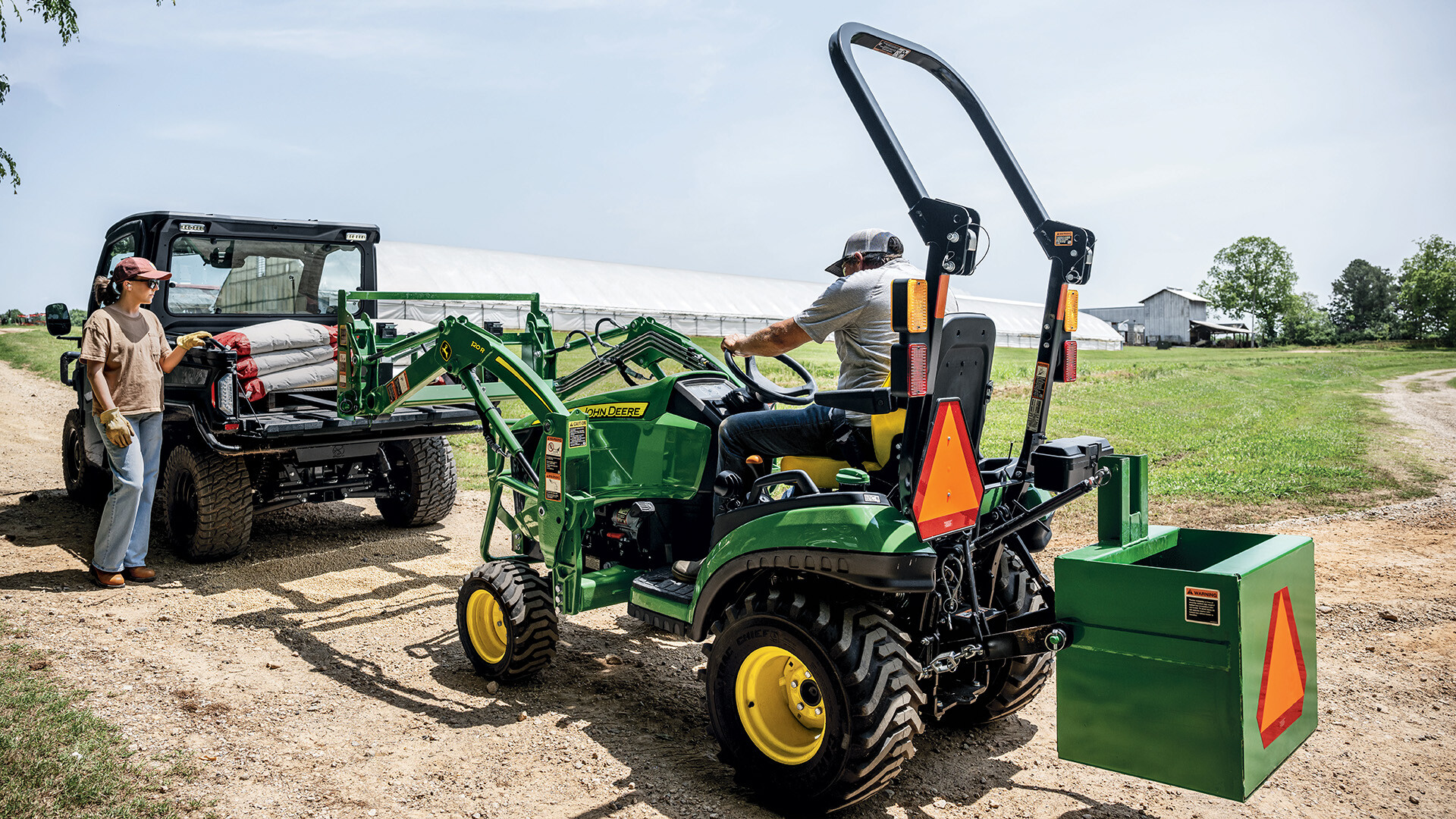
- Loader and hydraulic function. Cycle every hydraulic function through full range. Watch for slow lift, drift, or any noise under load.
- PTO engagement. Smooth engagement, no unusual noise at operating speed.
- Transmission behavior. For hydrostatic units, no jerkiness or excessive noise. For gear-drive, clean shifting through all gears.
- Front axle and steering. For 4WD units, engage 4WD and steer full lock both directions on a hard surface. Listen for u-joint or CV noise.
- Cooling system. Radiator fins clean, coolant level and condition, no signs of leakage.
- Electrical. Every light, gauge, and switch. Battery age and load capacity.
- Deck or attachments included. If a deck comes with the tractor, blade condition, spindle bearings, belt condition.
For any dealer-certified used listing, expect that Koenig has already run through this list before the unit went on the retail side. The purpose of the buyer walk-through is not to replicate the inspection, it is to verify the specific characteristics that matter to your intended use.
New versus used in this specific window
For customers weighing new against used right now, the arithmetic has a specific shape.
On the used side, late-August inventory is deep and freshly-priced. Selection is at the annual peak. Financing on used compact tractors through John Deere Financial is available on qualified units at rates that vary by unit age and buyer credit profile — the specialist can walk through options based on the specific tractor.
On the new side, the FY26 residential and compact tractor incentive programs mostly wrapped up on August 4th, but a few offers are still live. Notably, there is an active $2,750 cash purchase offer on 3E Series compact tractors (3025E, 3032E, and 3038E) that runs through November 1st, which changes the new-vs-used math for buyers considering that specific tier. The 1E and 2R Series do not have equivalent active cash programs at the moment, so the used lot is often the stronger value in those tiers right now.
The honest framework: if the specific new tractor you want has an active manufacturer incentive that reduces the new price meaningfully, work the new-vs-used comparison including that incentive. If it does not, or the incentive is small relative to the price, the used lot in late August offers real value and deep selection.
For a broader view of how model year timing and dealer inventory dynamics interact in this specific window, our August 11 post on late-summer buying and the model year cycle covers the framework in detail. The same logic applies to compact tractors, just with different specific dates.
Financing and warranty on dealer-certified used
Two things that separate the dealer-certified used experience from a private sale worth naming explicitly.
Financing through John Deere Financial is available on qualified used units. This is not the same as new-tractor financing programs, but it does offer competitive rates and terms structured around the used purchase. For buyers who prefer to preserve cash or run the tractor as part of a farm or contracting business, financing gives options that a private-sale cash purchase cannot match.
Warranty options vary by unit but often include the balance of any remaining factory warranty (for younger units) and, in some cases, extended service coverage through Koenig's dealer-certified used program. What is offered on a specific unit is one of the questions worth asking directly, because it changes the value proposition of that unit against alternatives.
Neither of these is available on a private-sale purchase from a Craigslist or Facebook Marketplace listing. That is not to say private-sale is wrong for every buyer, but the financing and warranty gap is real and worth valuing correctly in the decision.
When to shop, when to wait
For a buyer who has been thinking about a used compact tractor and is trying to decide when to actually make the trip, here is the honest read on the current window.
Shop now (mid-August through October) if: You want the deepest selection of the year. You want to see multiple units on the same visit to compare directly. You want fresh trade-in units where the recent inspection and service history are still recent. You are able to close a purchase this fall for use through winter.
Consider waiting to spring if: You are still 12+ months from actually needing a tractor and price is your primary constraint. Winter (December through February) tends to have softer pricing on the reduced inventory that is available, and if the specific unit you are looking for happens to be there, the deal can be strong. Spring buyers pay a premium for immediacy.
The most common mistake we watch buyers make in the used compact tractor market is waiting for the exact-right unit at the exact-right price in the wrong window. Selection and pricing move in ways that are not always aligned, and the right buying moment is usually when a good unit and a fair price line up, not when a perfect unit and a perfect price theoretically will.
When to call us
For the buyer actively shopping, calling ahead to check inventory is meaningfully faster than the online inventory feed for freshly-arrived units. Trade-ins that landed this week may not show online for another 5 to 10 days depending on the location. The parts and service team can also tell you what has come in recently that has not yet been photographed and listed.
For a buyer considering trade-in of an existing tractor as part of a new or used purchase, mid-to-late August is genuinely the right window to run those numbers. Trade-in valuations are current, new tractor selection is strong on the units with active programs, and used inventory to compare against is at annual peak.