Published: August 27, 2026
Updated: August 27, 2026
|
If your fall property work list includes an overgrown fence line, a pasture that got away from you during summer, brush along a ditch that has not been cut in two years, or a field edge that needs to be knocked down before the leaves fall, the right rotary cutter on your compact tractor makes a 4-hour job take 90 minutes and lets you actually finish before the weather turns. The wrong rotary cutter turns the same job into a broken drive shaft, a bent gearbox, or an operator giving up in frustration.
This is a working framework for selecting a rotary cutter that matches your compact tractor and your fall property use case. It builds on the July 30 fall prep attachments post and June 11 Frontier buyer's guide, and goes deep on the one attachment category most compact tractor owners size incorrectly the first time they buy.
Start with PTO horsepower
The single most important sizing constraint is PTO horsepower. Every rotary cutter has a minimum and maximum PTO HP rating, and running a cutter outside that window either underperforms in the field or damages the tractor. The math is straightforward:
- Compact tractors 25 to 30 PTO HP (1025R, 2025R class): rotary cutters up to about 60-inch deck, light-to-medium duty
- Compact tractors 30 to 40 PTO HP (2032R, 3025E, 3032E, 3038E class): rotary cutters up to about 72-inch deck, medium duty
- Utility tractors 40 to 60 PTO HP (4044M, 4066M, 5045E class): rotary cutters up to 72-inch deck in heavy duty, or 84-inch in medium duty
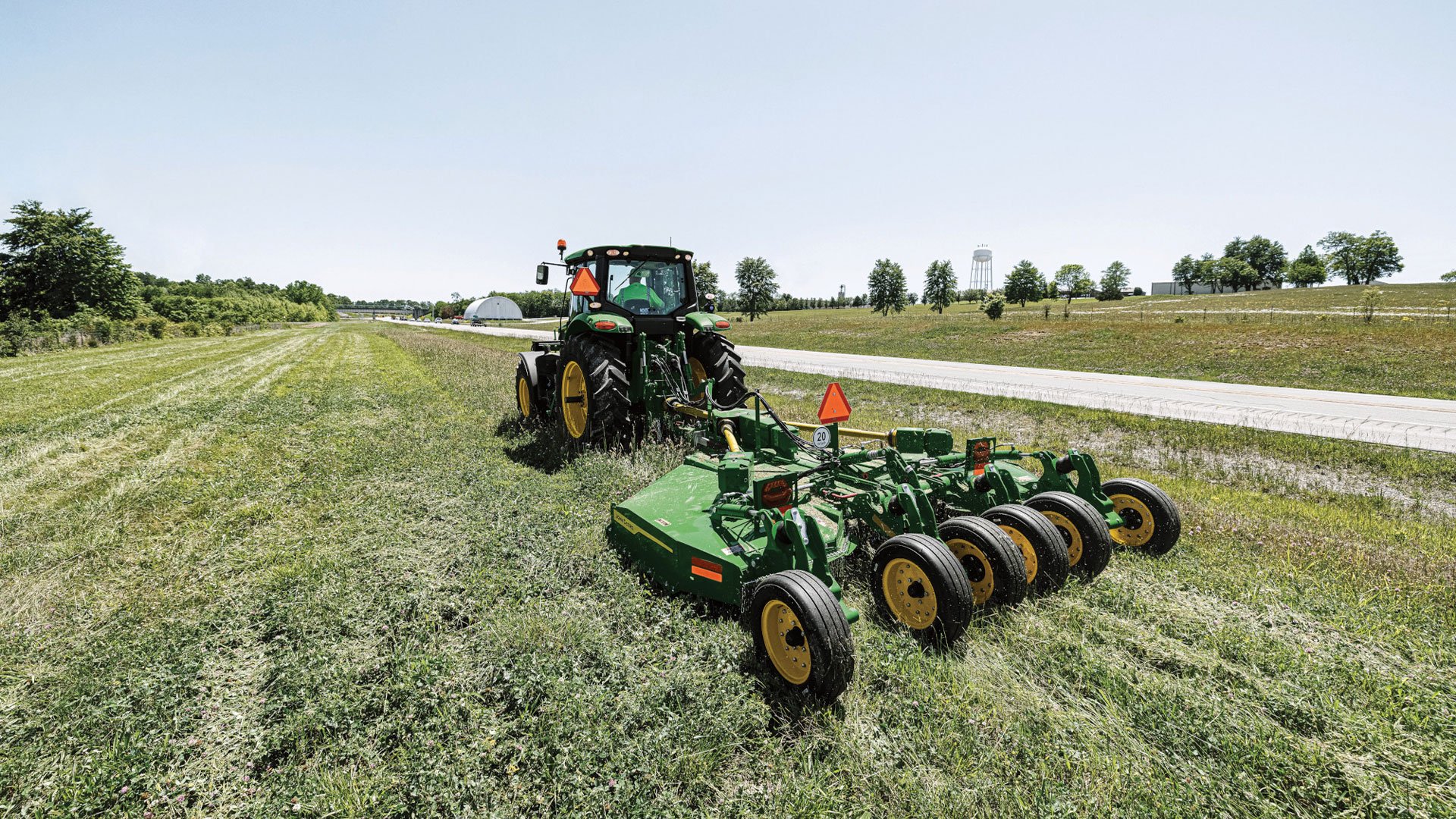
- Utility tractors 60-plus PTO HP (5E series and larger): 84-inch or wider decks in heavy duty, flex-wing designs open up
The mistake most first-time cutter buyers make is buying too much cutter for the tractor. A 72-inch heavy-duty cutter behind a 25 PTO HP subcompact tractor is not a bigger, more capable setup. It is a tractor that struggles to maintain PTO speed in tall grass, an operator who has to slow down constantly, and hydraulic and drivetrain wear that shortens tractor life meaningfully.
Deck size decisions
Match deck size to the width of the equipment path you want to cut in one pass, but do not exceed the PTO HP guideline above. The three common widths for compact tractor owners:
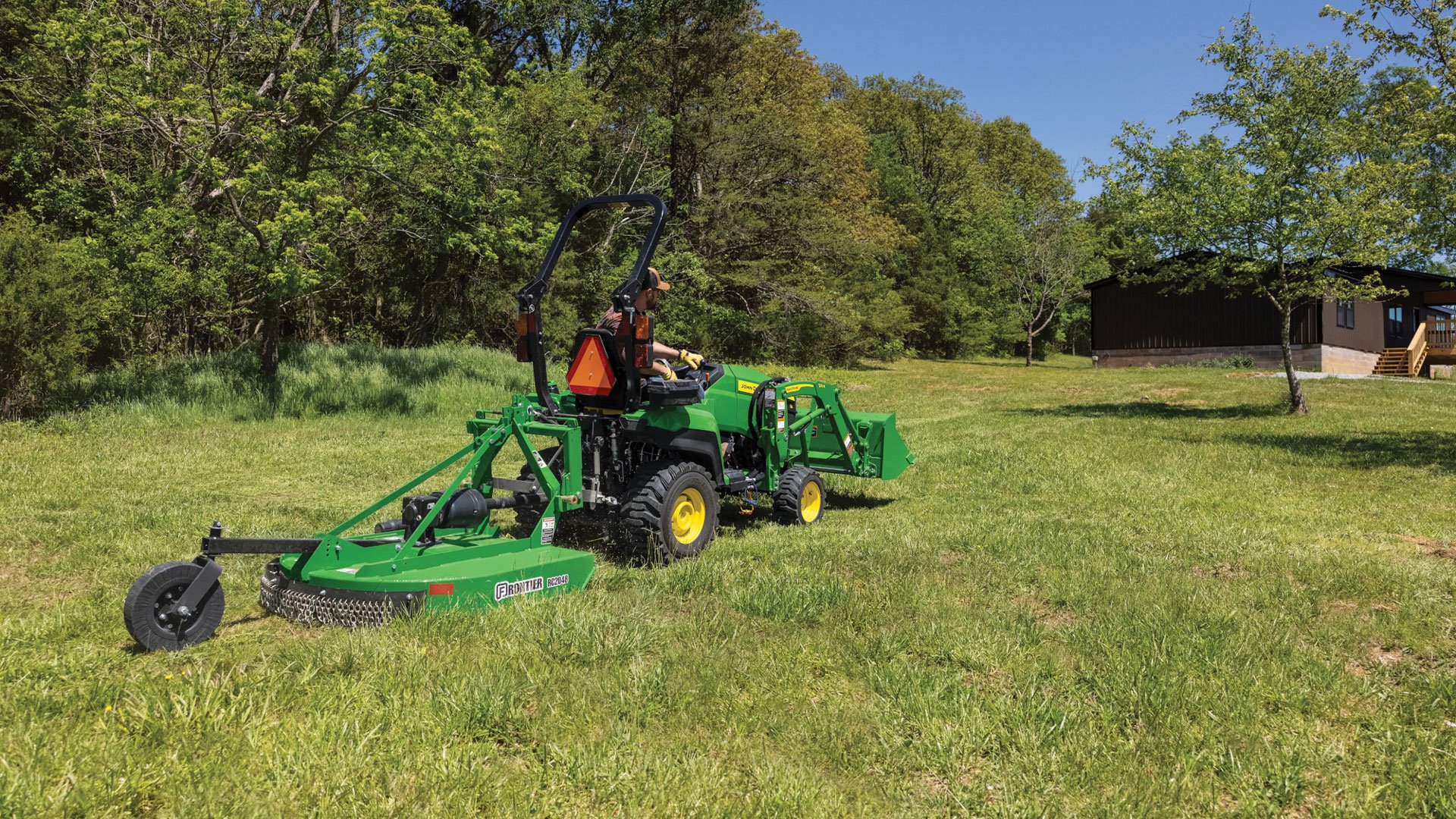
48-inch cutter. Fits behind 25-to-30 HP compact tractors comfortably. Right for owners with modest brush work, narrow fence lines, small pasture patches. Frontier RC2048 is the volume model in this size at Koenig.
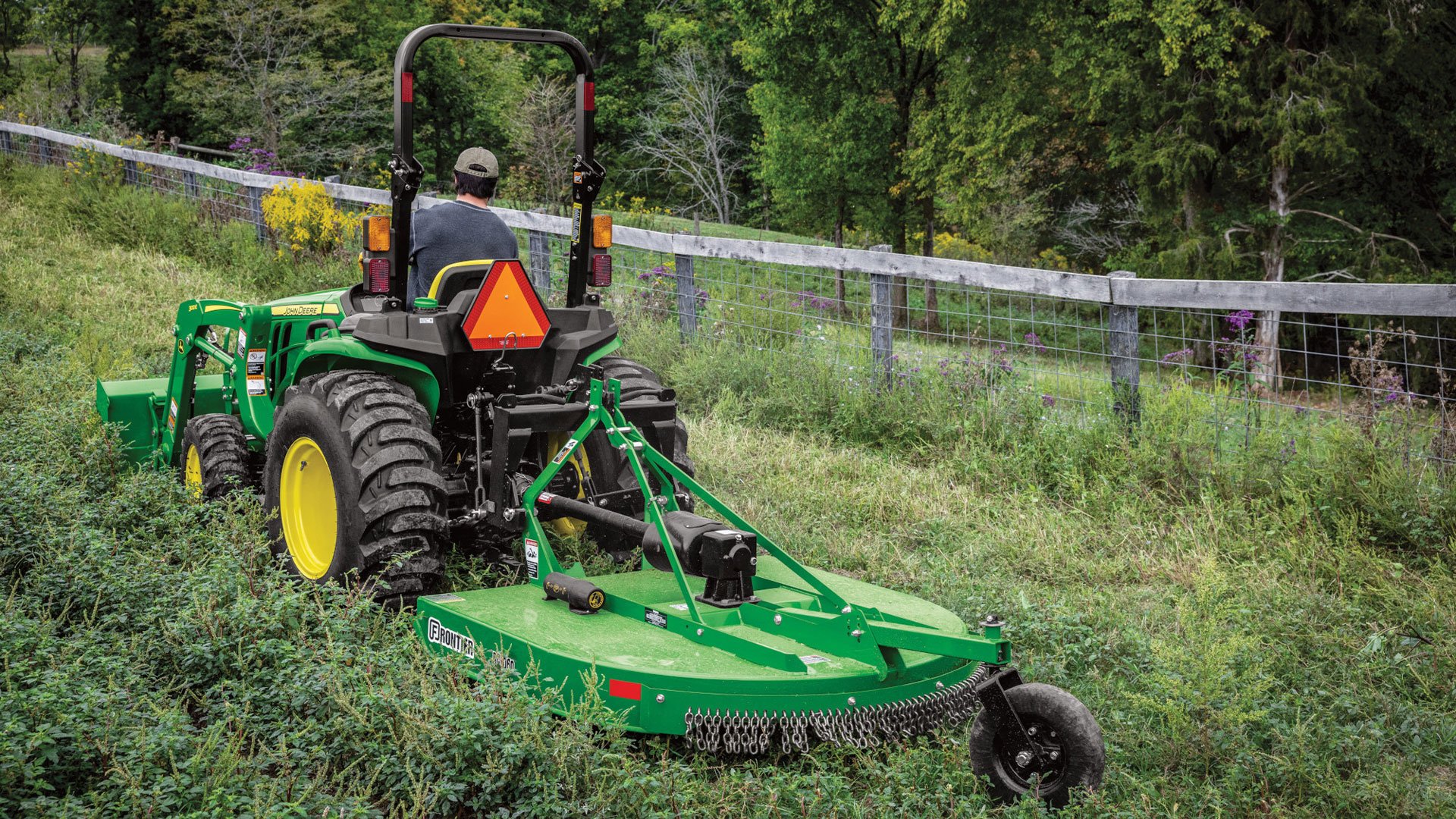
60-inch cutter. The middle-ground size that fits most 30-to-40 HP compact tractors. Handles most fall cleanup use cases including pasture maintenance, medium brush, and fence line work. Frontier RC2060 is the most common single-spindle cutter we sell in this size, and it is the model that ships in the 3038E Patriot Package for good reason — it matches the tractor cleanly.
72-inch cutter. Fits 35-to-50 HP tractors depending on duty rating. This is the largest single-pass width most compact and small utility tractor owners can properly power. Frontier RC2072 is common, and Deere's newer JD-branded lineup (RS72, RC78B, RX72) at the heavier-duty end also lands in this width class.
Wider than 72 inches typically means either a flex-wing design (which folds for transport) or a dedicated utility tractor. Both are outside the compact tractor conversation.
Light, medium, or heavy duty
Duty tier is the second axis buyers get wrong. Not every cutter of the same deck size is equivalent. The tiers:
Light duty. Rated for pasture maintenance, tall grass, brush up to about 1 to 1.5 inches diameter. Lighter deck weight, thinner gauge steel, smaller gearboxes. Right for the property owner cutting a couple times a year on ground that stays mowed most of the time.
Medium duty. Rated for regular pasture and brush work up to 2 to 2.5 inches diameter. Heavier deck construction, more robust gearbox. This is the sweet spot for most rural residential and hobby-farm owners doing meaningful fall cleanup.
Heavy duty. Rated for real brush and small tree work up to 3 inches or more. Meaningfully heavier construction, larger gearboxes, direct-drive on some models. The JD-branded RS72 goes up to 10-inch material and the RX72 handles similar territory. This is landscape-contractor and serious-brush territory rather than typical residential.
Match duty tier to what the ground looks like today, not to what you wish the ground looked like. The most common mistake is buying medium duty for what turns out to be heavy-duty ground, at which point the cutter accumulates wear fast and productivity suffers.
Pasture versus brush use case
The specific application drives the cutter selection more than most buyers realize.
Pasture maintenance is grass and light growth up to 8 to 12 inches tall, cut regularly. Light-duty cutters do this job well and are the right choice. Some pasture owners try to buy heavy-duty for the durability, but the added weight can actually damage well-established pasture during wet conditions.
Brush and overgrown ground is the case where duty tier matters most. Brush 1 to 3 inches in diameter requires medium-to-heavy-duty cutters. Attempting brush with a light-duty cutter breaks blades, warps decks, and eventually damages gearboxes.
Fence-line and ditch work is a specialized application. The cutter needs to hold up to occasional impact with fence posts, rocks, or debris. Heavy-duty deck construction and stump jumpers matter here more than in open pasture work.
Field-edge and headland cutting falls between pasture and brush depending on how often the edges get cut. If you cut the edges every year, medium-duty is enough. If you are catching up on 2 to 5 years of growth, heavy-duty is the honest recommendation.
Tail-wheel considerations
The tail wheel is one of the parts of a rotary cutter buyers pay least attention to and that matters most for cut quality and longevity.
Tail wheel size. Larger tail wheels track over uneven ground better and reduce the chance of the deck dragging on ridges or rocks. For compact tractor rotary cutters, a laminated or full-pneumatic tail wheel is the meaningful upgrade over the smaller solid wheels on some entry-level cutters.
Tail wheel type. Solid rubber tail wheels are common on light-duty cutters and adequate for smooth pasture. Pneumatic tail wheels ride uneven ground better but pick up occasional flats from thorns or metal debris. Laminated (semi-pneumatic) tail wheels split the difference and are typically the right choice for property owners in Ohio and Indiana who mix pasture with brush and fence-line work.
Tail wheel adjustment. The tail wheel is the primary cut-height adjustment on most rotary cutters. Make sure the specific model you are considering has an easy adjustment mechanism, ideally without requiring wrenches every time. Fall cleanup often means cutting at different heights across different areas of a property, and a hard-to-adjust tail wheel becomes a real time cost.
Safety chains and shields
Not the exciting part of the rotary cutter conversation, but the part that keeps operators safe and reduces liability exposure.
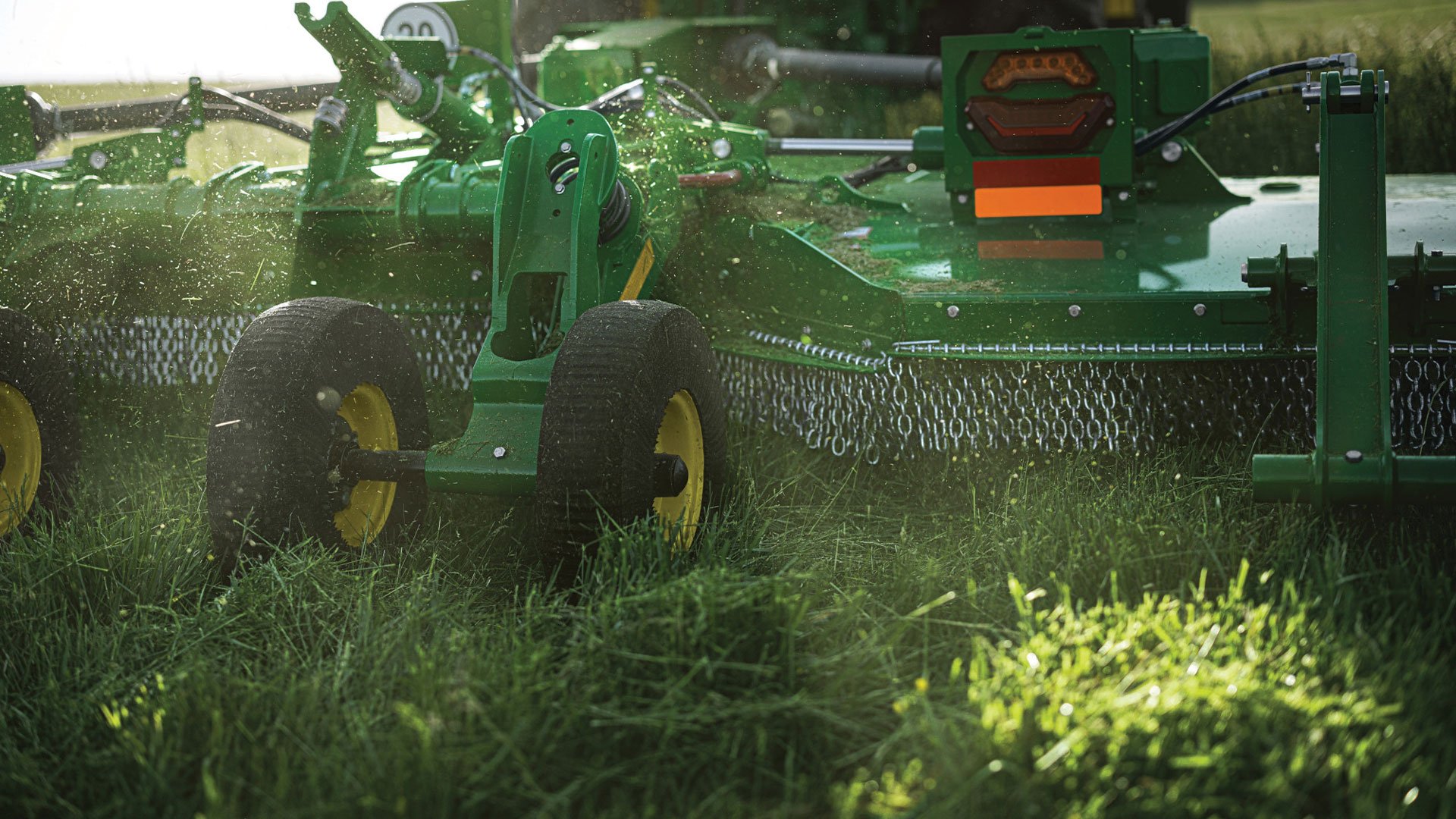
Safety chains. Rotary cutters throw debris — sticks, rocks, occasional wire. Full front and rear safety chain skirts contain most of what the deck kicks up. Cheap cutters skimp on chain coverage. Do not skimp on this yourself, especially on properties near roads, houses, or other people.
Deck shields. The shield over the PTO shaft is not optional. Any operator running a cutter without the shield installed is one clothing snag away from a serious injury. If a used cutter you are considering has a missing or damaged shield, factor in the replacement cost before you buy.
Chain and shield condition on used cutters. When shopping used, these are the components that show wear first and reveal how the cutter was maintained. Bent shield frames or missing chain sections are a signal to look harder at the rest of the machine.
The current Deere and Frontier rotary cutter lineup
At the compact tractor tier, Frontier-branded cutters are the volume line and pair naturally with the John Deere compact tractor lineup. The current options at Koenig:
Frontier RC-Series (RC2048, RC2060, RC2072) are the standard single-spindle rotary cutters covering 48-inch through 72-inch deck widths, matched to sub-compact through mid-compact tractors. These are the models included in most Koenig compact tractor packages, and the RC2060 in particular is the volume seller in Ohio and Indiana for property owners on 5 to 20 acres.
For the heavier-duty tier, John Deere's current lineup includes:
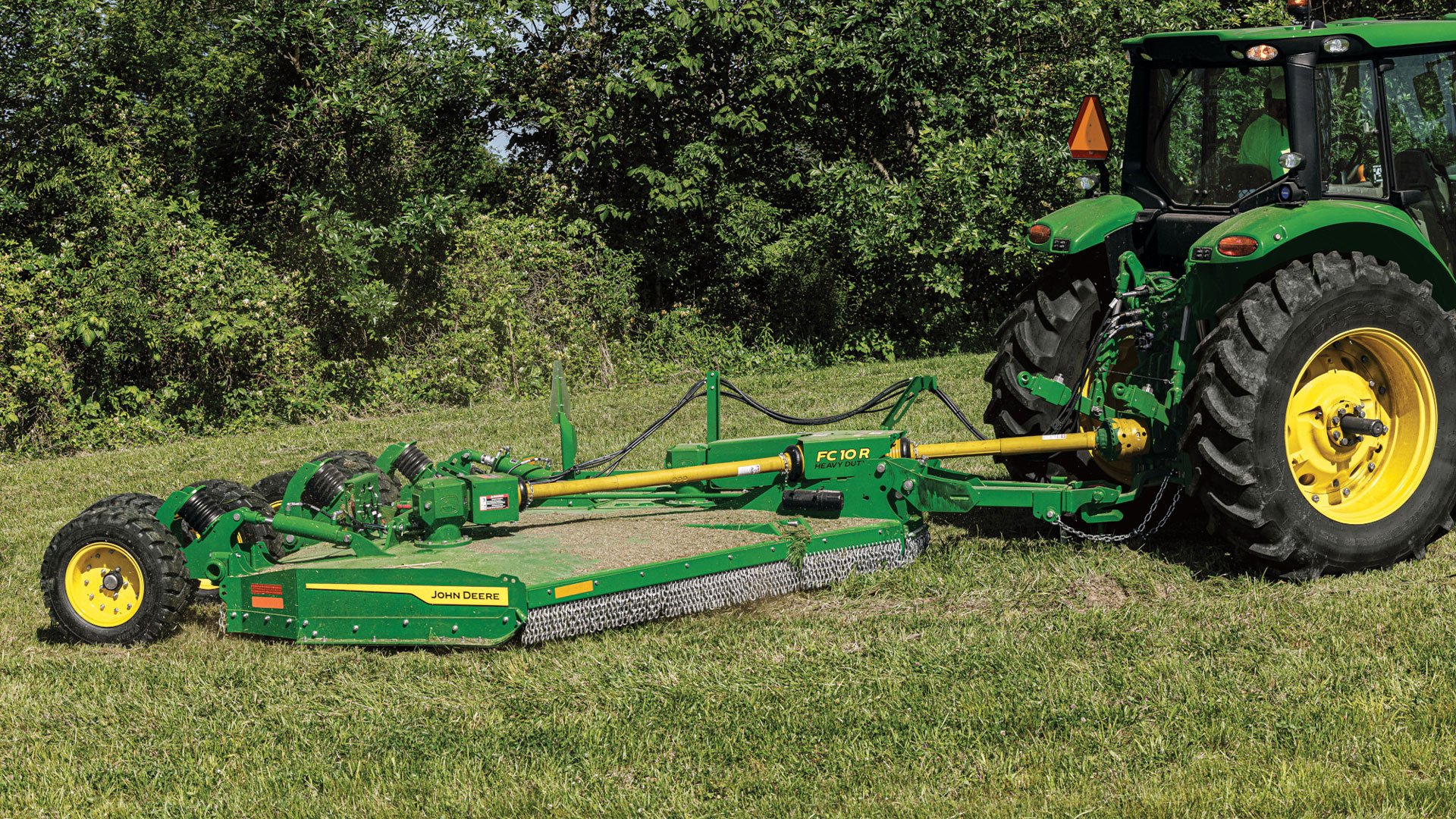
RS72 Rotary Cutter. Extreme-duty single spindle with a direct-drive system for durability. Rated for brush and trees up to 10 inches in diameter. This is the tool for landscape contractors and larger property owners with genuine heavy-brush work.
RC78B Rotary Cutter. Robust duty designed for agriculture and commercial landscaping. Wider deck, heavier construction than the compact-tractor Frontier RC line.
RX72 Rotary Cutter. Heavy-duty with a direct drive bearing for extended maintenance intervals and a retractable forward shield for operator safety on demanding brush work.
Beyond the Deere and Frontier lines, Koenig also carries Land Pride, Bush Hog, and Woods rotary cutters where those brands fit specific customer applications better. Not every job is a Frontier job, and the parts and service teams support all major brands.
Fall deck maintenance before the season starts
Whichever cutter you own or are about to buy, a short pre-season service pass makes the difference between a productive fall and a frustrating one.
- Blade inspection. Sharp blades cut cleanly and put less load on the tractor. Dull blades tear rather than cut, use more power, and stress the gearbox. Sharpen or replace annually.
- Blade bolts and stump jumper. Torque the blade bolts to spec, inspect the stump jumper (the round metal shield below the blades) for wear.
- Gearbox oil level. Check per the manufacturer's schedule. Low gearbox oil is the fastest way to destroy a rotary cutter under load.
- PTO shaft inspection. Check u-joints for play, verify guards are in place, grease per schedule.
- Deck welds and belly. Look for cracks in the deck welds and any thinning in the belly of the deck. Fatigue cracks propagate fast under load and are worth catching before they turn into a hole.
- Tail wheel bearing and pivot. Grease the tail wheel pivot and check the wheel bearing. These are the two failure points that strand a cutter in the field mid-job.
Buying a cutter this fall
For a customer considering a new rotary cutter purchase before the fall cleanup window, timing is tight but workable. Frontier RC-series cutters are typically in stock or available within 2 to 4 weeks at Koenig. Heavier-duty JD-branded models may run 3 to 6 weeks depending on configuration.
On the offer side, if you are pairing a new rotary cutter with a new John Deere 5E utility tractor (5045E, 5055E, 5065E, or 5075E), there is an active bundle offer running through November 1st: $250 off with the purchase of 2 new John Deere or Frontier implements, tiered up to $400 off with 5 or more. For anyone building out a fall attachment lineup on a new utility tractor purchase, that bundle offer makes the arithmetic on adding a cutter genuinely favorable.
For buyers pairing a cutter with a new 3E Series compact tractor (3025E, 3032E, 3038E), the current $2,750 cash purchase incentive on the 3E lineup runs through November 1st as well. The compact-tractor-plus-implements bundle program has cycled off, but the tractor-side cash offer is real and worth valuing correctly against the total package.
Used rotary cutter inventory rotates through August and September as property owners upgrade or downsize. Used cutters can be a strong value for buyers whose applications are moderate, as long as blade, deck, and shield condition are honestly assessed before purchase.
When to call us
For a compact tractor owner sizing a rotary cutter for the first time, a 10-minute call with the parts and attachment team walks through PTO HP, property description, and use case honestly and lands on a recommendation. That conversation is faster than working through the online catalog on your own.
For pre-season service on an existing cutter, our service teams can typically fit a full pre-fall inspection and blade sharpening within 5 to 10 business days of a call. Later in September the shop backlog builds fast, so this week is meaningfully easier to schedule than late September.