Published: June 16, 2026
Updated: October 1, 2026
|
If you have spent any time on the Gator section of our site, you have probably noticed something. There are two main families of John Deere Gators, and they live in very different places on the lot. The HPX series sits in the Work series row, painted the kind of utilitarian green that looks right at home next to a skid steer. The XUV series sits a few rows over, often with brighter trim, a cargo bed that tilts a little quicker, and a seat that hints at more weekend miles.
Both will haul a load of feed, both will pull a small trailer, and both wear the Deere name. So the question we hear constantly at our stores across Ohio and Indiana is a simple one. Which series actually fits my property.
The short answer is that the HPX is built for work first and everything else second. The XUV is built to do real work too, but with enough comfort, speed, and versatility that it is comfortable doing chores Monday morning and a ride down the back lane Saturday afternoon. The longer answer is what the rest of this post is about.
What is the difference between a Gator HPX and an XUV
The HPX and XUV are both classified as crossover utility vehicles in Deere's lineup, but they sit on different chassis and target different buyers.
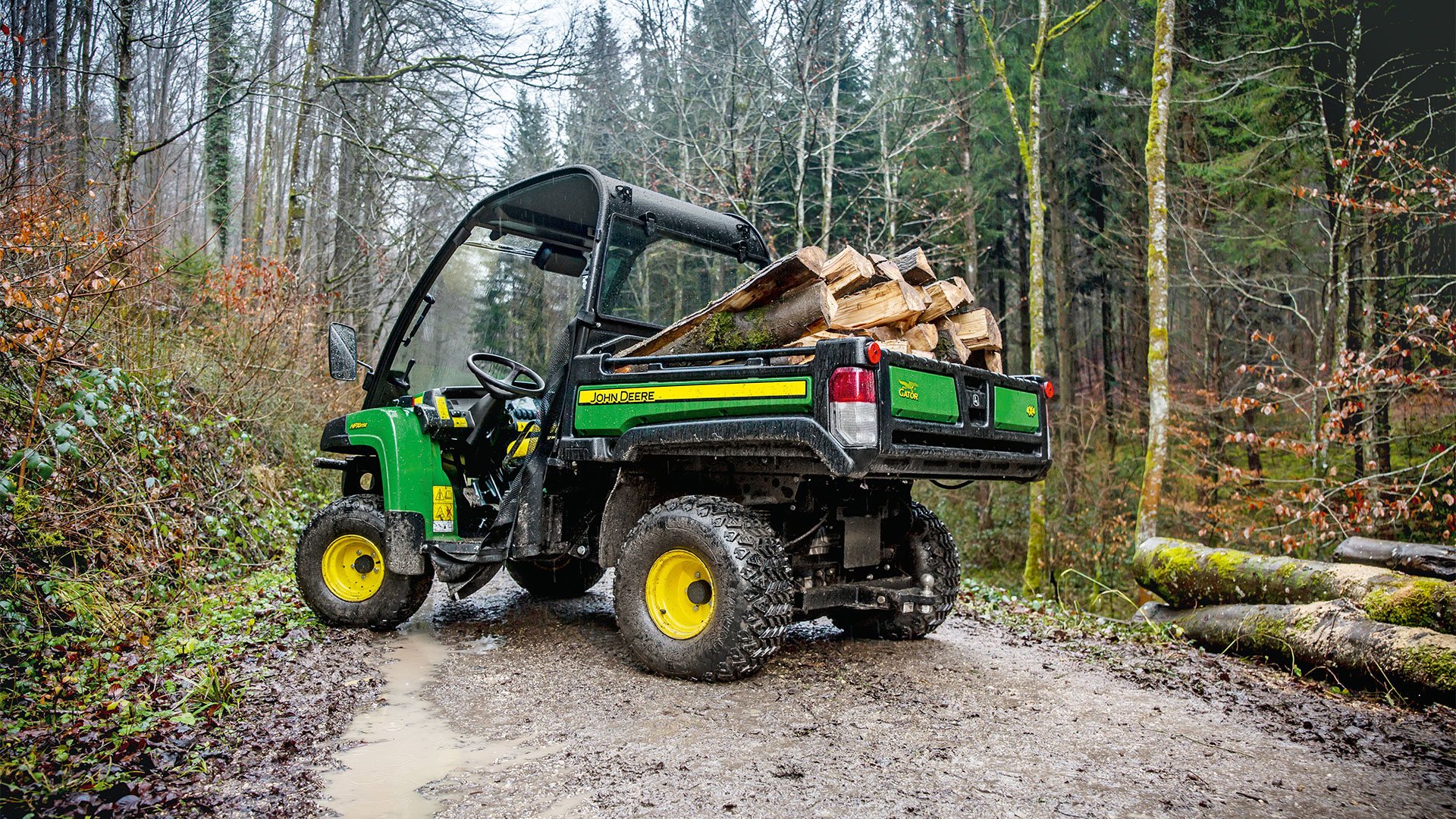
The HPX is the heart of Deere's Work series. Steel cargo box, manual dump, simple controls, leaf-spring or De Dion rear suspension depending on the year, and a top speed in the low-to-mid 20 miles per hour range. Engineering decisions throughout the HPX favor durability and serviceability over comfort. The HPX 615E is the current flagship of this group, powered by a 20-horsepower Kawasaki gas engine, full-time true 4WD, and a cargo box rated for 1,000 pounds.
The XUV series moves up the comfort and capability ladder. There are mid-size XUVs (the 590M and 560E platforms) and full-size XUVs (the 835 and 845 and 865 and 875 families). Across that range you get more horsepower, more top speed, four-wheel independent suspension on most full-size models, and a cargo box that is often hydraulic or power-assisted on the higher trims. The cab option matters too. Most XUVs can be ordered with a sealed HVAC cab. The HPX cannot.
So when you stand at the lot looking at the green next to the green, here is the real split. The HPX is a work tool with a seat. The XUV is a vehicle that happens to be very good at work.
Who buys an HPX
The HPX is the right pick when you spend most of your time on the same fence-line, in the same barn, on the same back-forty, and when the vehicle is going to take a beating that you do not want to flinch about.
The buyers we see drive HPX 615Es home are typically:
- Working farms that already have an XUV or a side-by-side for the family. The HPX becomes the chore truck. Feeding cattle, hauling fence supplies, moving tools from shop to field.
- Equine operations that need a quiet, predictable vehicle that does not spook horses and can be hosed out at the end of the day.
- Rural landowners with 10-plus acres who genuinely use a utility vehicle as a utility vehicle. They are not looking for trail miles or a top speed past 25.
- Small municipal and grounds crews that need something that runs all day with minimal fuss and is easy to service.
If you are the kind of buyer who has fixed your own equipment for 20 years and you appreciate that the HPX has fewer electronics, fewer screens, and fewer parts that can fail in a way that strands you mid-task, this is your platform.
Who buys an XUV
The XUV is the right pick when the utility vehicle has to wear more hats. Chore platform Monday through Friday. Family ride to check the back of the property on Sunday. Hunting rig in November. Maybe even a small plowing setup come December.
The buyers we see drive XUVs home are typically:
- Property owners on 5 to 50 acres who want one vehicle that handles everything. The XUV 590M and 835M are extremely popular for this profile.
- Hunters and outdoor recreationists who want the speed and ground clearance to cover a property quickly and the suspension to handle washouts and rough trails.
- Larger working farms that want a cab-equipped vehicle for cold mornings, wet days, and dusty harvest work. The 835M HVAC and 865M HVAC trims are common picks here.
- Construction sites and commercial properties where superintendents need a fast, comfortable way to move between sites without taking a pickup.
The XUV gets ordered with creature comforts that the HPX does not offer. A sealed cab with heat and air. A premium sound system. Power steering on most trims. A power-dump cargo box. Higher payload and towing in the upper trims. You pay for those features. They also genuinely change the experience of driving the vehicle for hours at a time.
The price gap, and what it actually buys
A current HPX 615E typically lands in the low-to-mid 13,000 dollar range new at Koenig, before any options or financing programs. A base mid-size XUV 590M starts around 16,000 dollars. A full-size XUV 835M without a cab is in the 19,000 to 23,000 range depending on configuration. A 835M with the HVAC cab moves into the high 20,000s. Signature edition full-size XUVs with leather, premium audio, and full cabs can exceed 35,000 dollars.
The price gap from HPX to base XUV is real but not enormous. The bigger jump is between a base XUV and a fully optioned full-size XUV with a cab. Where the extra money goes:
1. Speed and engine. HPX 615E tops out near 25 miles per hour. A 590M will run closer to 45. A full-size XUV with the bigger engine will run faster than that, with much more torque available. 2. Suspension. HPX uses a simpler, more rugged rear setup. Full-size XUVs use four-wheel independent suspension that smooths out rough trails and ruts at speed. 3. Cab and comfort. A sealed HVAC cab transforms the vehicle into a year-round chore truck. The HPX cannot be ordered with one. 4. Cargo capacity. HPX 615E box: 1,000 lbs. Full-size XUV 800-series box: up to 1,000 lbs gas or 1,200 lbs diesel, with hydraulic or power-assisted dump on most trims. 5. Towing. HPX 615E: 1,300 lbs. Full-size XUV: up to 2,000 lbs depending on configuration. 6. Refinement. Power steering, electronic differential lock, more seating options, more storage, better sealing against dust and water.
If the work you need done falls cleanly inside the HPX's comfort zone, paying for the XUV's extra capability is paying for capacity you will not use. If your usage stretches the HPX, the XUV pays for itself in comfort and fewer trips.
Hauling and towing, by the numbers
Hauling and towing is where the two platforms separate most clearly. Here is what we tell customers to take home and put against their actual chore list.
HPX 615E - Cargo box: 1,000 lbs capacity, manual dump, steel construction - Towing: 1,300 lbs - Total payload (including driver and passenger): around 1,400 lbs
XUV 590M (mid-size) - Cargo box: 600 lbs capacity, gas-assisted dump - Towing: 1,500 lbs - Total payload: around 1,200 lbs
XUV 835M (full-size, gas) - Cargo box: 1,000 lbs capacity, hydraulic dump available - Towing: 2,000 lbs - Total payload: around 1,600 lbs
XUV 875M (full-size, diesel) - Cargo box: 1,200 lbs capacity, hydraulic dump - Towing: 2,000 lbs - Total payload: around 1,750 lbs
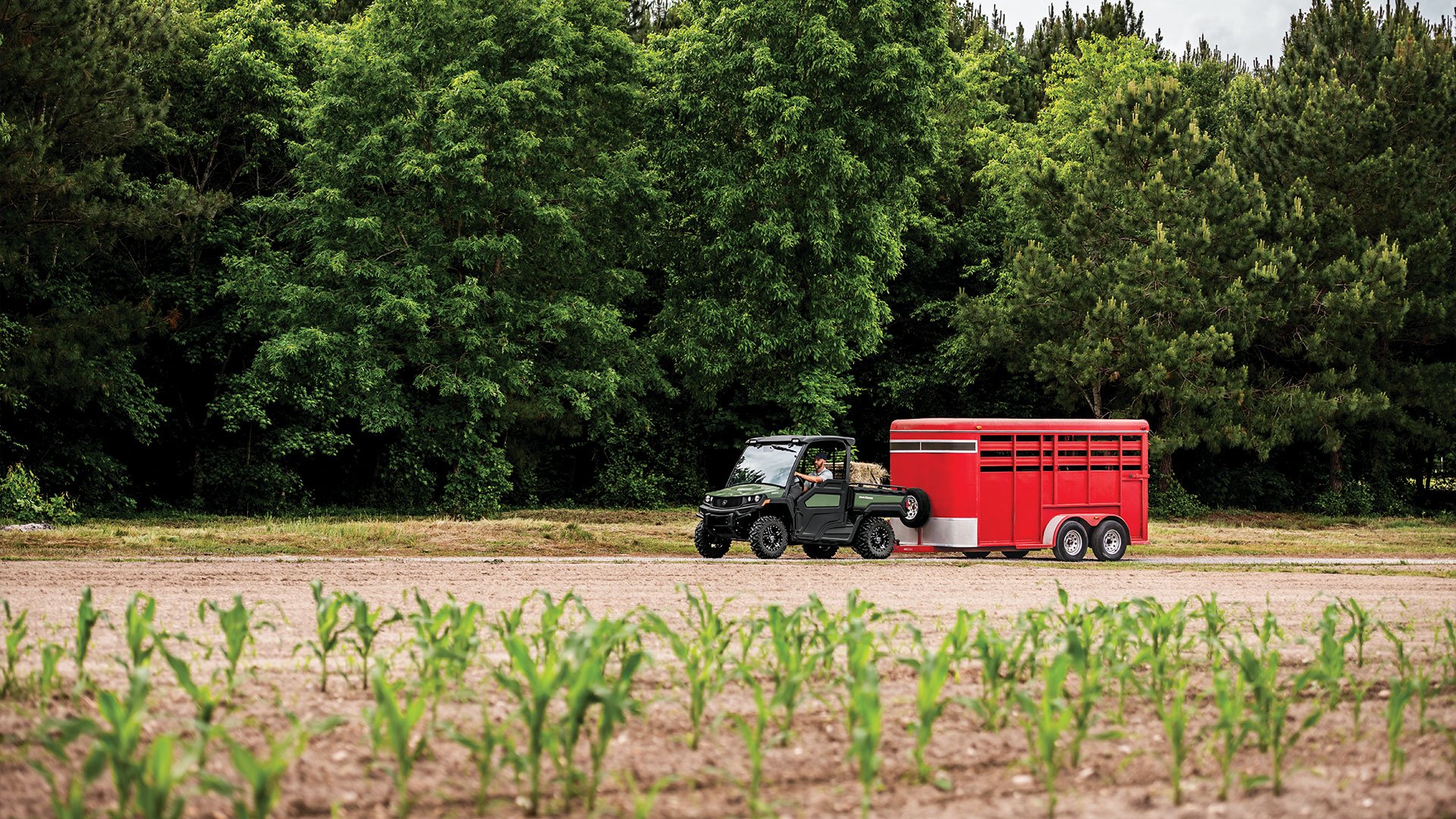
A few practical notes from the lot. The HPX has the simplest dump bed in the lineup, and customers who load and unload feed or fertilizer all day appreciate the mechanical predictability. The XUV's power dump is genuinely useful when you are working alone and the bed is heavy. The diesel XUVs are the towing champions, and the diesel torque shows up most when you are dragging a loaded trailer up a wet hill, not on a flat barnyard.
Suspension and ride quality
If you have spent a long day in an HPX, you know the ride is honest. It tells you what the ground is doing. The De Dion rear and the simpler front geometry are great for stability with a heavy load, less great for absorbing washboard or ruts at speed.
Full-size XUVs run four-wheel independent suspension with longer travel. The result is a vehicle that you can run at 35 to 40 miles per hour across a hayfield without your back letting you know. For property owners who are crossing larger acreage routinely, this is not a luxury feature. It is the feature that determines whether you want to take the Gator or take the truck.
The XUV 590M is in the middle. Independent rear suspension, faster than an HPX, smaller and lighter than a full-size XUV. It is a Goldilocks pick for many of our 10-to-25-acre property buyers.
Seating, cabs, and weather
The HPX seats two. You can order a roof, a windshield, and side panels, but you cannot order a sealed cab with heat and air. The HPX is built around an open-air, work-first design.
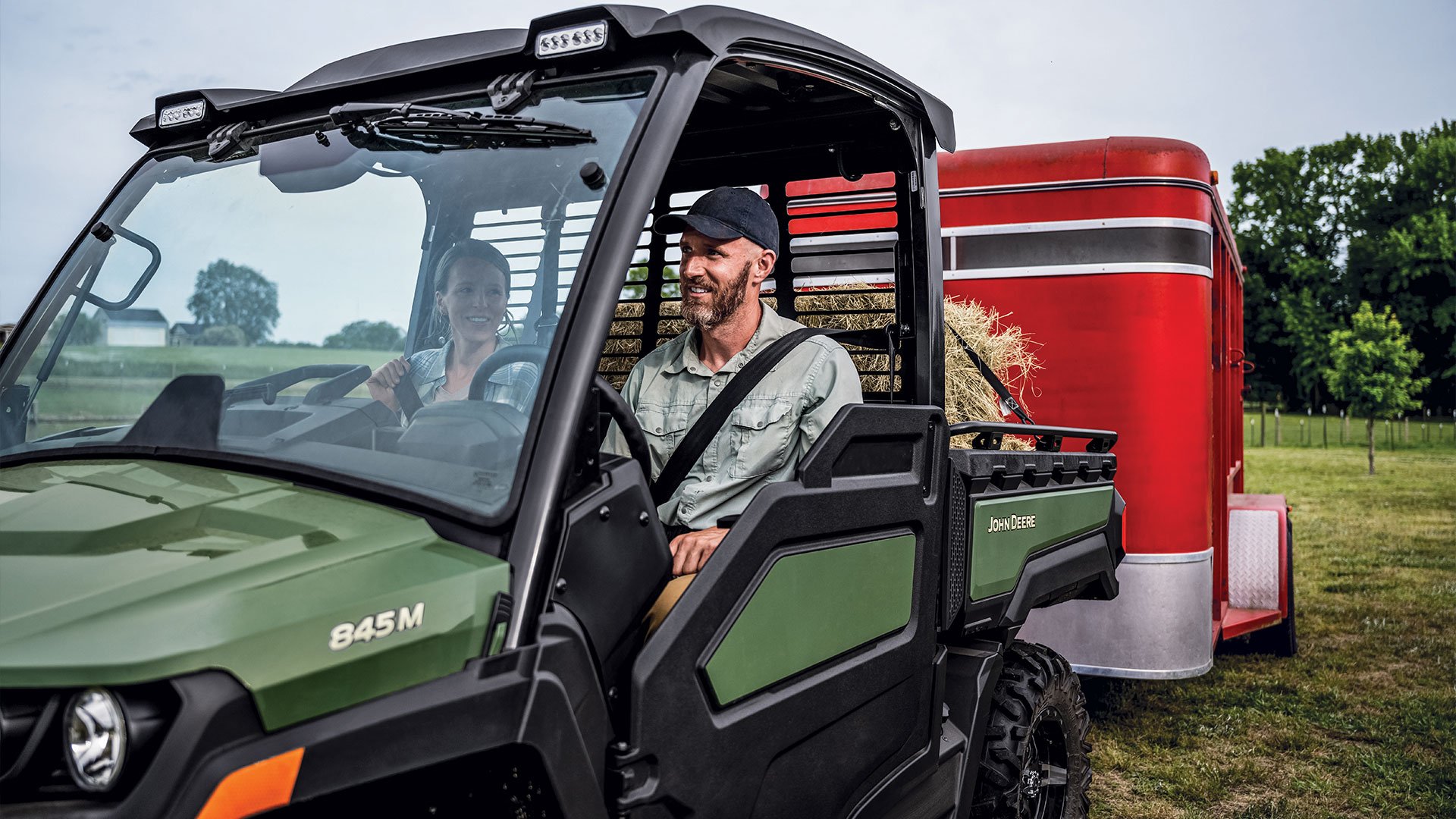
The XUV opens up the seating conversation. The 590M and most full-size XUVs are available in two-passenger or four-passenger crew configurations. The S4 (Sport-4) trims add a rear bench. You can order most full-size XUVs with a full HVAC cab, which makes the vehicle viable in February or August in a way an HPX simply is not.
For property owners who do meaningful chores in December or January, the cab option is often the deciding factor. There is a real difference between bundling up to ride an HPX out to a frozen waterer and driving the same chore in a heated XUV cab.
Maintenance and the long view
Both platforms are well-supported through our service department, and parts availability for both is strong. The HPX has fewer electronic systems and a simpler driveline, which means fewer failure points and lower long-term cost on the systems that exist. Owners who plan to keep a utility vehicle 15 years tend to love the HPX for that reason.
The XUV has more capability and more systems to maintain: power steering, HVAC, power-dump hydraulics, more sophisticated electronics. None of it is fragile, but it is more to keep track of. The good news is that the same service department that handles your tractor handles your Gator, and most wear items are stocked locally.
Used Gators
Both HPX and XUV hold their value well, and our used inventory typically includes a healthy mix. Used HPX units tend to come from working farms, often with hours but maintained on schedule. Used XUVs cover a wider spectrum, from low-hour recreational units to higher-hour ranch trucks. If you are price-sensitive but want the platform that fits your work, a used unit is often the right move. You can browse current inventory on the used ATVs and Gators page anytime.
How to make the decision
Here is the framework we walk customers through when they ask us to help them choose.
Pick the HPX if most of these are true: - You are on the same property doing the same work most days - You rarely need to cover ground at speed - You do not need a sealed cab - You appreciate simpler mechanical systems - Your budget is closer to the 13,000 to 15,000 range - The vehicle will spend more time hauling and dumping than it will moving people
Pick the XUV if most of these are true: - The vehicle will cover real ground, possibly across multiple properties or larger acreage - You want the option of a cab for year-round use - You may use the vehicle recreationally as well as for chores - You want more seating capacity (crew or four-passenger) - You want higher towing or payload for a specific job - The vehicle is going to be in service most days for years to come
If you cannot make the call on paper, our team is happy to put you behind the wheel at one of our locations. A 15-minute demo on each platform usually settles it. The HPX feels like a work tool. The XUV feels like a vehicle.
Companion read
If you want the broader Gator lineup overview before committing to HPX or XUV specifically, our John Deere Gator Buyer's Guide walks through every current model.
Not sure which Gator is right for you?
Answer a few quick questions and Koenig will match you to the right John Deere Gator for your property, based on how you work and what you need.